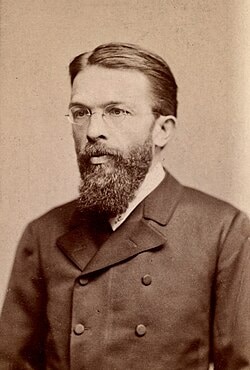
Carl Menger
 Austria
Also known as: Carl Menger Edler von Wolfensgrün
生日
February 28, 1840
星座
Pisces
出生地
Neu-Sandec, Kingdom of Galicia and Lodomeria, Austrian Empire (now Nowy Sącz, Poland)
年龄
80岁去世
简介
Carl Menger was an Austrian economist who founded the Austrian school of economics. His 1871 book Principles of Economics introduced the subjective theory of value and marginal utility, reshaping how economists understand value. Menger argued that value is determined by individuals' preferences, not by labor costs or inherent properties of goods. This directly challenged classical economists like Adam Smith, David Ricardo, and Karl Marx.
Today, Menger's ideas continue to influence economic thought, particularly in entrepreneurship and market process theory. His disciples Eugen von Böhm-Bawerk and Friedrich von Wieser expanded his work, and Friedrich Hayek later stated that the Austrian school's fundamental ideas belong fully to Menger. Though he published relatively few works, their impact has been profound.
早年生活与背景
卡尔·门格尔出生于奥地利帝国加利西亚地区新桑茨的一个富裕的小贵族家庭。他的父亲安东是一名律师,母亲卡罗琳是一位富有的波西米亚商人的女儿。他有两个兄弟:安东,后来成为法学教授和社会主义作家;马克斯,一名律师,曾任奥地利议会的自由派议员。门格尔家族包括工匠、音乐家、公务员和军官,他们都在他出生前一代从波西米亚移民而来。
门格尔在布拉格大学和维也纳大学学习法律和政府科学。他在维也纳的一位老师是彼得·米施勒,他是边际价值理论的支持者,但当时门格尔对经济学或学术生涯并不感兴趣。1867年,他在克拉科夫的雅盖隆大学获得法学博士学位。
毕业后,门格尔于1863年开始为《兰博格日报》担任记者。他创办了《维也纳日报》,该报于1865年11月26日首次出版。在早期的一期中,他匿名发表了一部标题耸人听闻的小说《维也纳的永恒犹太人》。1866年3月,他加入政府控制的报纸《维也纳报》的经济编辑部,成为一名政府雇员,并处于快速晋升通道。
在担任商业记者期间,门格尔注意到现有经济理论(尤其是古典经济学)与买家在真实市场中的实际推理方式之间存在不一致。这一观察促使他发展了自己的理论框架。
职业发展
1871年,门格尔出版了他的开创性著作《经济学原理》(Grundsätze der Volkswirtschaftslehre)。该书引入了边际效用概念和主观价值论,认为商品的价值源于其与人类需求的关系。这部著作创立了奥地利经济学派,并与威廉·杰文斯和莱昂·瓦尔拉斯一起,成为边际效用革命的三个独立表述之一。
出版一年后,门格尔获得了维也纳大学的教授资格。他于1873年被任命为副教授,1879年成为正教授,并一直担任此职位直至提前退休。他拒绝了外国大学的任命。
从1876年到1878年,门格尔担任奥地利王储鲁道夫的私人导师和密友,并通过德国、法国、瑞士和英格兰进行了广泛的学习旅行。1883年,他出版了《社会科学方法论探究》,为理论研究辩护,反对德国历史学派,引发了方法论之争。
职业生涯年表
公众形象与风格
名气与粉丝圈
Carl Menger, the founder of the Austrian School of Economics, is not currently ranked in iFANN's Global Fame Engine. Despite his monumental influence on economic thought, the engine has evaluated him as unranked, meaning he holds no placement in the published Global Top 1,000 or any Top-100 scope list. This absence reflects the quiet, academic nature of his legacy rather than any lack of significance.
His admirers form an intellectual community rather than a conventional fanbase, and no formal fandom name exists. The Austrian School tradition itself, with institutions like the Mises Institute and the Foundation for Economic Education, serves as the closest analogue, preserving and promoting his work with near-reverential dedication. Rituals such as the Carl Menger Essay Contest and scholarly conferences mark his legacy, but these are academic observances, not fan gatherings.
Menger's fame, then, is of a peculiar kind, profound within economics, yet largely invisible to the broader public. The legendary tales surrounding him are intellectual: the 1871 publication of Principles of Economics, the bitter Methodenstreit with the German Historical School, and his insights into spontaneous order. These stories are retold in classrooms and seminars, not in stadiums. His standing is that of a founding figure whose ideas continue to shape discourse, even as the global fame metrics pass him by.
趣闻与传奇
Carl Menger Edler von Wolfesgrün, though he and his brothers never used their title of nobility, was a true polymath in his youth, intellectually vigorous into old age. He founded the journal Wiener Tagblatt and published an anonymous novel titled Der ewige Jude in Wien in its early issues. Initially uninterested in economics or an academic career, he preferred non-academic writing.
Menger's 1871 Principles of Economics is the foundational legend of the Austrian School, born from his observations of real market behavior that contradicted classical theory. The Methodenstreit, his bitter methodological dispute with Gustav von Schmoller, became a heroic tale of theory versus bureaucratic establishment, cementing the school's outsider identity. His 1883 Investigations into the Method of the Social Sciences introduced the concept of spontaneous order, explaining how institutions like money emerge without design. A peculiar legend involves obituaries for other men named Carl Menger, occasionally surfacing and causing confusion about the economist's 1921 death.
著名语录
“The value of goods arises from their relation to our needs, and is not something inherent in the goods themselves.”
“In real life there are only concrete goods and concrete wants.”
“The degree of mankind's economic progress will be proportional to the advancement of human knowledge.”
家庭与个人生活
重要关系
恋情与交往史
- 已婚门格尔妻子的详细信息在标准传记资料中记载不多。
逝世与身后事
逝世
February 26, 1921 (享年80岁)
逝世地点
Vienna, Austria
死因
Natural causes associated with advanced age
Carl Menger spent his final days in Vienna, continuing his academic work and writing until shortly before his passing. He died on February 26, 1921, at the age of eighty following a long illness that was consistent with natural causes associated with advanced age. The circumstances were treated as a peaceful departure by those who witnessed them. The economic community responded with profound respect, recognizing him immediately as the founder of the Austrian School and a principal architect of the Marginalist Revolution. Tributes focused on his theoretical contributions, particularly the subjective theory of value and marginal utility, which he co-discovered alongside William Stanley Jevons and Léon Walras. While specific details regarding the date and location of his funeral service remain unrecorded in standard biographical sources, it is historically established that he was buried in Vienna.
Notable figures within his intellectual circle, including Ludwig von Mises and Friedrich Hayek, mourned his loss as the end of an era for classical liberal economic thought. His posthumous influence has been immense, with institutions such as the Samford University Brock School of Business establishing the Carl Menger Essay Contest to honor his legacy. The Mises Institute continues to publish extensively on his life and works, solidifying his status as the sole founder of the Austrian School. Modern commentary frequently cites his theories in relation to libertarian movements.
获奖 (1)
1900 · 荣誉任命
代表作
Principles of Economics
1871 · Author
Investigations into the Method of the Social Sciences
1883 · Author
关键词
来源
速览
- 职业
- economist, professor
- 出生
- +1840-02-28
- 出生地
- Neu-Sandec, Galicia, Austrian Empire
- 逝世
- +1921-02-26
- 逝世地点
- Vienna, Austria
- 性别
- 男
- 星座
- Pisces
- Education
- Doctorate in law, Jagiellonian University (1867)
个人资料
- 全名
- Carl Menger Edler von Wolfensgrün
- 子女
- Karl Menger
- 教育
- Doctorate in law from Jagiellonian University in Kraków (1867)
常见问题
卡尔·门格尔以什么闻名?
卡尔·门格尔结婚了吗?他有孩子吗?
卡尔·门格尔是如何去世的?
卡尔·门格尔最著名的著作是什么?
卡尔·门格尔去世时多大年纪?
相似人物
加入社区
位粉丝正在讨论