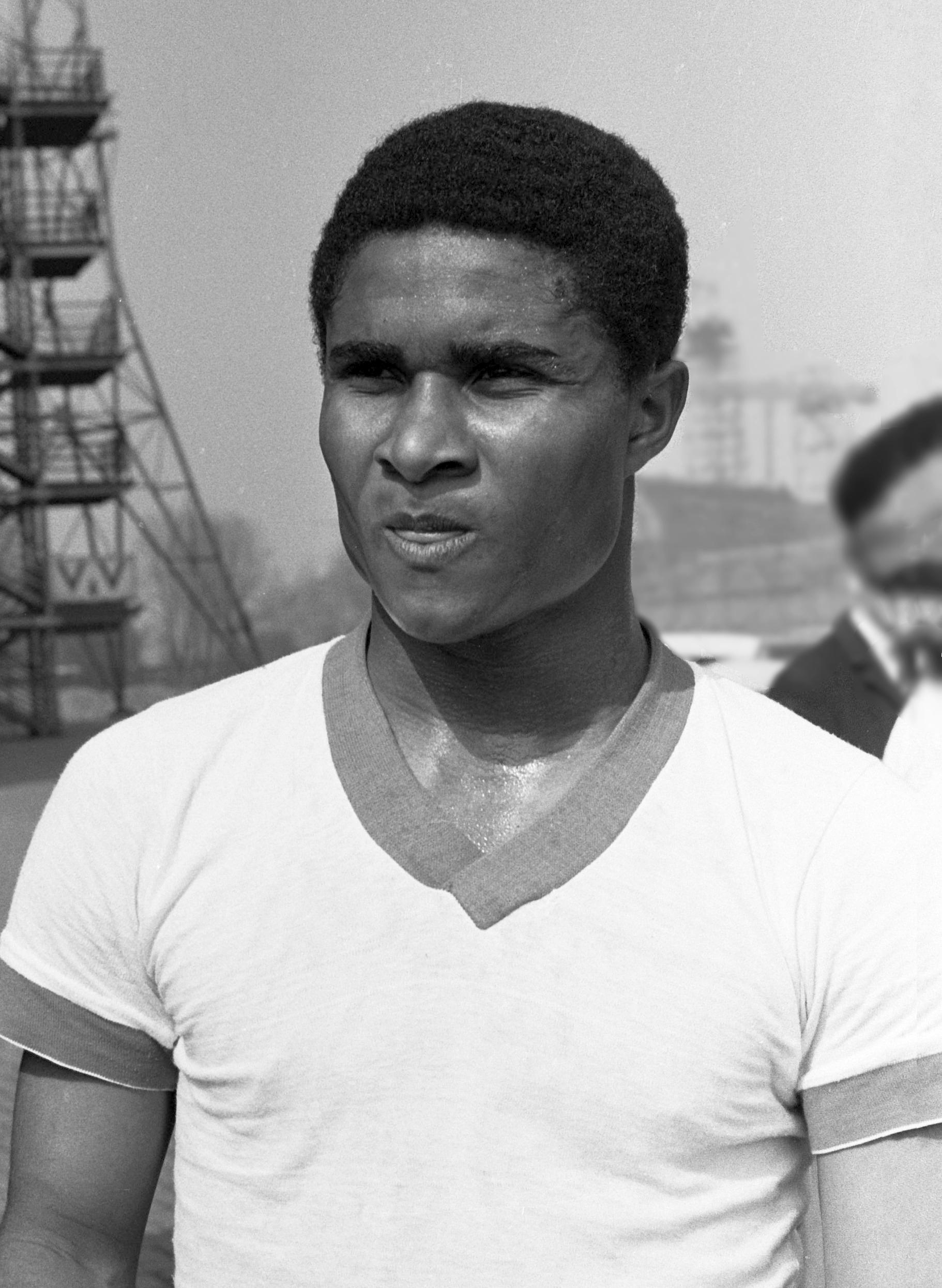
Eusébio
 Mozambique
association football player•athlete
Also known as: Black Panther, Black Pearl, O Rei
生日
January 25, 1942
星座
Aquarius
出生地
Maputo, Portuguese Mozambique (now Mozambique)
年龄
71岁去世
身高
5 ft 9 in (175 cm)
简介
Eusébio da Silva Ferreira 是一位葡萄牙足球运动员,被广泛认为是历史上最伟大的前锋之一。他以惊人的速度、强力的右脚射门和非凡的运动能力而闻名,在745场职业生涯比赛中攻入733球。Eusébio 是本菲卡队史最佳射手,在440场正式比赛中攻入473球,并带领葡萄牙队在1966年世界杯上获得第三名,以9个进球赢得金靴奖。他于1965年获得金球奖,并是首位获得欧洲金靴奖的球员,且两次获此殊荣。他的奖杯包括11次葡超联赛冠军和一次与本菲卡一起赢得的欧洲冠军杯。退役后,他担任足球全球大使,至今仍是葡萄牙备受爱戴的民族英雄和非洲足球的偶像。球迷和同行尊称他为“O Rei”(国王)。
早年生活与背景
Eusébio 在马普托的 Mafalala 街区长大,那是一个贫穷的郊区,他经常赤脚用塞满报纸的袜子当足球踢。他的父亲是一名葡萄牙白人铁路工人,在 Eusébio 八岁时去世,使家庭陷入贫困。他大约12岁辍学,打零工(包括擦鞋和机械师助手)来养活母亲。15岁时,他加入了 Sport Lourenço Marques 的青年队,在第一个赛季攻入55球。1960年,他被选中代表莫桑比克参加巴西的一项赛事。本菲卡球探 José Carlos Bauer 原本被派去观察另一名球员,却被 Eusébio 的表现震惊。本菲卡主席 Maurício Vieira de Brito 以约7,500英镑的价格谈判了他的转会,Eusébio 于1960年12月抵达里斯本,即将年满19岁。
职业发展
Eusébio 在1961年5月23日对阵桑托斯的一场友谊赛中完成了本菲卡首秀,并上演帽子戏法。他的正式比赛首秀是在1961年6月1日对阵贝伦人。在1962年欧洲冠军杯决赛中,他梅开二度,帮助本菲卡5-3击败皇家马德里,成功卫冕。他于1965年获得金球奖,成为首位获此殊荣的葡萄牙球员。在1966年世界杯上,他在6场比赛中攻入9球,包括在四分之一决赛对阵朝鲜时攻入4球,赢得金靴奖。他于1968年以42个联赛进球赢得首届欧洲金靴奖,并于1973年以40个进球再次获此殊荣。他七次获得葡超最佳射手奖(Bola de Prata),创下纪录。在本菲卡效力15个赛季后,他于1975年离开,在440场正式比赛中攻入473球。之后他效力于波士顿民兵、蒙特雷、多伦多大都会-克罗地亚(1976年赢得NASL冠军)、拉斯维加斯水银和圣何塞地震,于1978年退役。
职业生涯年表
公众形象与风格
Eusébio 的比赛风格以惊人的速度、强力的右脚射门和非凡的运动能力为特点。他通常穿着白色本菲卡球衣和黑色短裤。媒体将他描绘成一个谦逊、慷慨且非常忠诚的人物,常称他为“O Rei”(国王)。本菲卡球迷(称为 Benfiquistas)对他近乎神圣地崇敬;他的13号球衣已被俱乐部退役,他在光明球场外的雕像是一个朝圣地。球迷在比赛中高唱他的名字。由他遗产管理方运营的官方社交媒体账号用葡萄牙语和英语发布历史片段和致敬。Eusébio 既被尊为葡萄牙民族英雄,也被视为非洲足球的偶像。
名气与粉丝圈 (iFAMOUS Rankings)
Eusébio da Silva Ferreira is currently evaluated by the iFANN Global Fame Engine as holding no placement in the published rankings, a status that reflects his standing as a historical figure rather than a current trending entity. While he does not occupy a spot within the Global Top 1,000 or any scope-specific top-100 lists as of August 2026, his enduring presence remains anchored in the institutional memory of Portuguese football and the broader global consciousness of the sport's history. His fanbase lacks a single, globally recognized official name distinct from the clubs he served; supporters identify primarily through their allegiance to S.L. Benfica or the Portuguese national team. Within these groups, Eusébio is revered not merely as a player but as a cultural icon, often referred to collectively by his nicknames "O Rei" (The King) and "A Pantera Negra." The term "Black Panther" evokes a mythology surrounding his speed and ferocity, transcending sports to enter the Portuguese cultural lexicon. The club itself serves as the primary vessel for this fandom, with the Estádio da Luz functioning as a pilgrimage site where fans sing his name during matches. Posthumously, his legacy has been maintained through high-profile tributes initiated by state institutions and the club, including a prominent statue in Lisbon and an archive dedicated solely to his career at the Museu do Sport Lisboa e Benfica. A significant interaction occurred in 2026 when Cristiano Ronaldo surpassed Eusébio's World Cup goal record, sparking public discourse among fans who actively compared modern achievements against the benchmarks set by the late legend.
趣闻与传奇
Eusébio's powerful right-footed shot was measured at 120 km/h (75 mph), a feat of physical capability that defined his era. He was the first African-born player to win the Ballon d'Or and scored a hat-trick on his Benfica debut against a Santos side featuring Pelé. In the 1966 World Cup quarter-final, Portugal trailed North Korea 3–0 after 25 minutes; Eusébio scored four goals to secure a 5–3 victory, a story fans still retell as the moment Portugal came of age on the world stage. He turned down a move to Real Madrid in 1965 to remain at Benfica and was never sent off in his entire professional career. A heavy smoker, he reportedly consumed two packs of cigarettes daily during his playing days. The nickname "Black Panther" was coined by French journalists following a match against Stade de Reims. Beyond his statistics, the narrative of his death and state funeral in 2014 solidified his transition from sporting hero to national saint, with millions lining Lisbon streets to bid him farewell. Recent discussions have also framed his legacy through the lens of colonial history, noting how he was celebrated while the realities of his birthplace were often softened in the national mythos.
著名语录
“I never thought about records. I just wanted to play football and score goals.”
“Benfica is my life. I owe everything to this club.”
“When I played, I played for the love of the game. The money was secondary.”
“I am proud to be African, proud to be Portuguese, and proud to have represented both.”
家庭与个人生活
Eusébio 是 Laurindo António Ferreira(葡萄牙白人铁路工人)和 Elisa Anissabeni(莫桑比克黑人女性)的第四个孩子。他八岁时父亲去世。他于1965年12月28日与 Flora Claudina Burheim(一位有德国血统的葡萄牙女性)结婚。他们育有两个孩子:Carlos(1966年出生)和 Sandra(1969年出生)。Eusébio 和 Flora 一直保持婚姻关系,直到他2014年去世。他的儿子 Carlos 管理着他的遗产和公众形象。家人住在里斯本,Eusébio 以对家庭深厚的情感而闻名。
重要关系
Eusébio 与贝利关系密切,贝利称他为“我见过的最伟大的球员”。他在本菲卡和葡萄牙的中场搭档是 Mário Coluna,锋线搭档是 José Torres。教练 Béla Guttmann 签下了他,并带领本菲卡赢得了1962年欧洲冠军杯。Eusébio 的儿子 Carlos Ferreira 管理着他的遗产和公众形象。
恋情与交往史
尤西比奥于1965年12月28日与弗洛拉·克劳迪娜·伯海姆结婚,直至2014年去世。两人通过里斯本的共同朋友相识,并举行了天主教婚礼。他们育有两个孩子:卡洛斯(1966年出生)和桑德拉(1969年出生)。婚姻持续了48年,期间没有公开的分居或离婚报道。截至2026年,尤西比奥已去世;去世时,他仍与弗洛拉保持婚姻关系。
- 已婚Flora Claudina Burheim1965 - 2014通过里斯本的共同朋友相识;举行了天主教婚礼;育有两个孩子;保持婚姻关系直至尤西比奥去世。
逝世与身后事
逝世
January 5, 2014 (享年71岁)
逝世地点
Lisbon, Portugal
死因
心力衰竭
Eusébio da Silva Ferreira spent his final days receiving treatment for respiratory and cardiac complications at the Hospital de Santa Maria in Lisbon, having largely withdrawn from public view due to declining health. He passed away on January 5, 2014, at the age of 71, with official statements from his family and Benfica club officials confirming the event occurred following a period of hospitalization. The cause of death was reported as heart failure, a condition consistent with his long-standing health issues. Public reaction to his passing was immediate and global, characterized by an outpouring of grief from the football community, including tributes from FIFA, UEFA, Pelé, Franz Beckenbauer, and Cristiano Ronaldo.
The Portuguese government declared three days of national mourning, while fans gathered spontaneously outside the Estádio da Luz and the hospital to lay flowers and light candles. A moment of silence was observed during major football matches worldwide, honoring the man who led Portugal to a third-place finish at the 1966 World Cup. The funeral took place on January 8, 2014, in Lisbon as a state funeral held at the National Pantheon before his burial at the Cemitério dos Prazeres. The ceremony featured religious rites and eulogies attended by thousands of mourners, including President Aníbal Cavaco Silva and Prime Minister Pedro Passos Coelho, marked by a military honor guard and the playing of the national anthem.
Posthumously, the stadium where he played his entire club career was renamed the Estádio da Luz, Eusébio in 2015, and a statue now stands prominently outside the ground. The Eusébio Foundation continues to operate focusing on social projects and youth football development in Mozambique and Portugal, while several books and documentaries have been released analyzing his 1966 performance. His estate remains managed privately without public dispute.
身价(遗产价值)
$10 Million
iFANN编辑团队估算
Per iFANN's editorial analysis, Eusébio da Silva Ferreira had an estimated net worth of $10 Million at the time of his death in 2014. This figure represents the accumulated value of his illustrious playing career, most notably his tenure with Benfica, where he earned substantial salaries and bonuses throughout his prime. Additionally, he benefited from various endorsement deals and public appearances, though specific figures from those contracts are not publicly detailed. Following his retirement, Eusébio served as a global ambassador for football, a role that provided ongoing income and sustained his financial standing until his passing. His net worth reflects a lifetime of achievement in the sport, with earnings derived from contracts, endorsements, and later ambassadorial roles contributing to his financial legacy.
获奖 (20)
尤西比奥在1965年赢得金球奖,并且是欧洲金靴奖的首位得主,分别在1968年和1973年获得该奖。他在1966年以9个进球获得世界杯金靴奖,并三次成为欧洲冠军联赛最佳射手。在国内,他创纪录地七次获得葡萄牙足球超级联赛最佳射手奖。他六次被评为葡萄牙年度最佳足球运动员。2003年,欧足联将他评为葡萄牙黄金球员,2004年他入选了贝利评选的FIFA 100名单。
1965 · 最佳球员
Benfica / Portugal
1973 · 最佳射手
Benfica
1968 · 最佳射手
Benfica
代表作
1966 FIFA World Cup
1966 · Portugal striker (9 goals, Golden Boot)
Benfica
1961 · Striker (all-time top scorer, 473 goals)
Ballon d'Or
1965 · 获奖者
European Cup
1962 · Winning goalscorer in final
关键词
速览
- 职业
- association football player, athlete
- 出生
- +1942-01-25
- 出生地
- Maputo
- 逝世
- +2014-01-05
- 逝世地点
- Lisbon
- 性别
- 男
- 配偶
- Flora Claudina Burheim
- 星座
- Aquarius
个人资料
- 全名
- Eusébio da Silva Ferreira
- 身高
- 5 ft 9 in (175 cm)
- 配偶
- Flora Claudina Burheim
- 子女
- Carlos Ferreira (son, born 1966), Sandra Ferreira (daughter, born 1969)
常见问题
尤西比奥去世时多大年纪?
2026年尤西比奥的身价是多少?
尤西比奥结婚了吗?
为什么尤西比奥被认为是有史以来最伟大的足球运动员之一?
尤西比奥在1966年世界杯上进了多少球?
相似人物

加入社区
位粉丝正在讨论