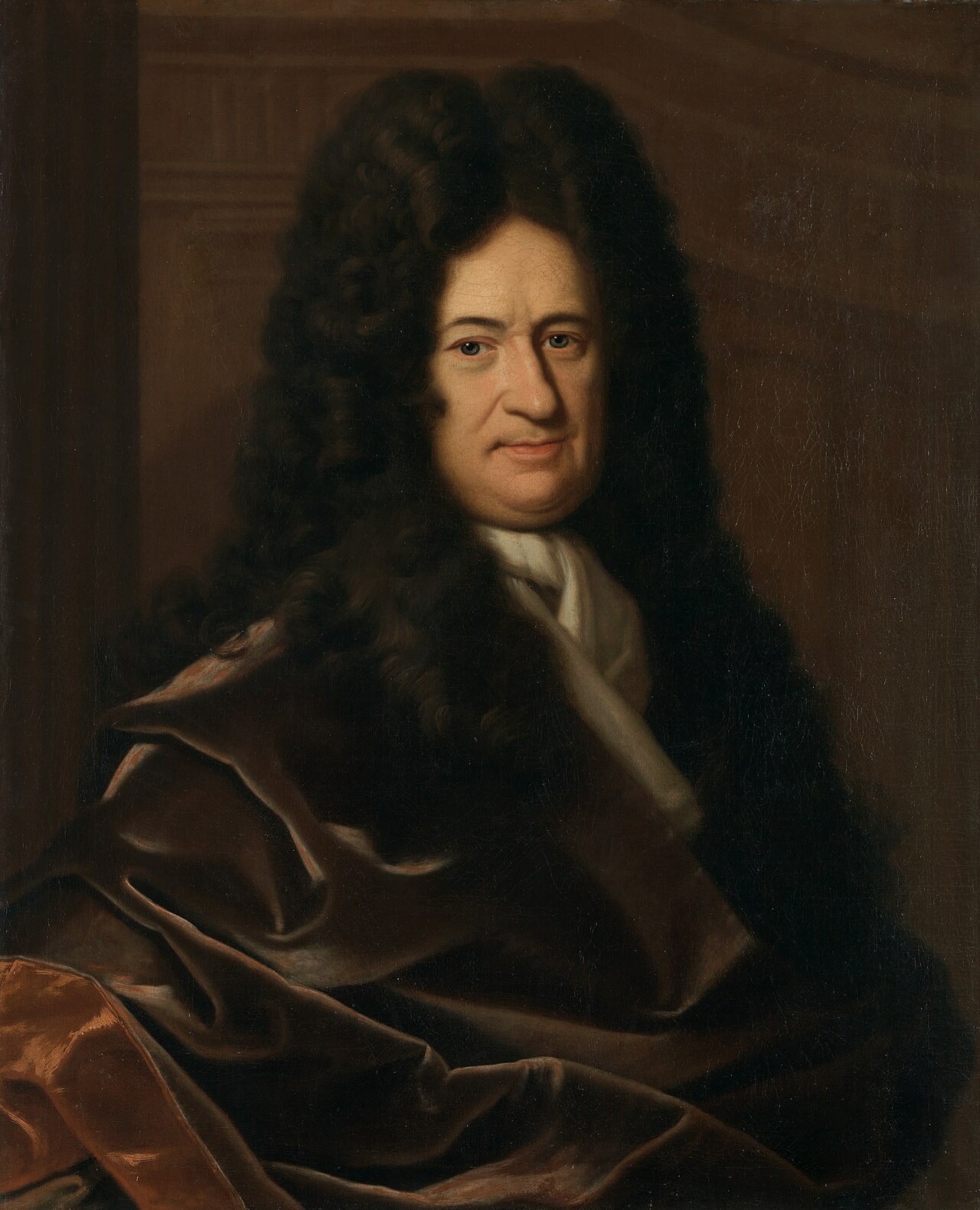
Gottfried Wilhelm Leibniz
mathematician•jurist•physicist
生日
July 1, 1646
星座
Cancer
出生地
Leipzig, Saxony, Holy Roman Empire
年龄
70岁去世
简介
戈特弗里德·威廉·莱布尼茨是一位德国博学家,其研究涵盖数学、哲学、科学、法律和外交。他常被描述为那个时代最后一批几乎掌握人类全部知识的思想家之一。在数学领域,他以独立于艾萨克·牛顿发展微积分而闻名,他设计的优雅导数与积分符号至今仍是学生学习的内容。他还发明了后来支撑数字计算的二进制系统,并早在电子计算机出现前几个世纪就制造了机械计算器。作为哲学家,他与宏大的形而上学思想相关联,包括他的单子理论以及备受争议的“这是所有可能世界中最好的一个”的论点,该论点后来被伏尔泰讽刺。他的好奇心几乎无限,撰写了关于神学、历史、地质学、语言学、图书馆学和政治改革的著作,其中大部分散见于信件和期刊而非成书。与牛顿在微积分优先权上的争执困扰了他的晚年。如今,他被视为现代数学和哲学的奠基人,他对逻辑和计算的预见从信息时代的角度看愈发具有预言性。
早年生活与背景
17世纪中叶的莱比锡是一座从三十年战争中恢复的城市,莱布尼茨于1646年7月1日出生于此。他的父亲弗里德里希·莱布尼茨是莱比锡大学的道德哲学教授,在男孩年仅六岁时去世。但弗里德里希留下了一个庞大的私人图书馆,年幼的戈特弗里德通过阅读父亲的书自学了拉丁语。七岁时他已能流利阅读拉丁语;十二岁时自学了希腊语。十五岁时他进入莱比锡大学学习哲学和数学。1662年获得学士学位,两年后获得哲学硕士学位。随后转向法律,1665年获得学士学位,1666年在阿尔特多夫大学获得法学博士学位。同年他出版了第一本书《组合术》,提出了一种通用符号语言,为符号逻辑奠定了基础。他拒绝了阿尔特多夫的教授职位,转而选择为美因茨选帝侯担任外交官、法律顾问和图书馆员。
职业发展
1672年,莱布尼茨前往巴黎执行外交任务。在那里,他师从克里斯蒂安·惠更斯学习数学,并开始发展微积分。1673年他访问伦敦,向皇家学会展示了一台计算器,并被选为院士。到1675年,他已独立发展出微积分,创造了至今仍在使用的符号(dy/dx, ∫)。1676年,他进入汉诺威的布伦瑞克家族服务,在那里作为图书馆员、历史学家和外交官度过余生。1679年,他完善了二进制系统。1684年,他在《求极大和极小值的新方法》中发表了第一篇关于微积分的论文。1686年,他发表了《形而上学论》,概述了他的哲学体系,包括单子理论。1700年,他创立了柏林科学院并担任首任院长。1710年,他出版了最著名的哲学著作《神正论》,1714年出版了《单子论》,这是其形而上学的简明阐述。他于1716年去世,由于与牛顿在微积分优先权上的激烈争执,他在很大程度上被忽视。
职业生涯年表
公众形象与风格
莱布尼茨被描绘成典型的博学家,一个拥有百科全书式知识、优雅符号和宏大形而上学体系的人。他的形象常是17世纪宫廷服饰配长假发。在流行文化中,他有时被描绘成才华横溢但天真的思想家,特别是关于“最好世界”的论点。他常与牛顿形成对比:莱布尼茨是系统化、乐观的哲学家,牛顿则是隐秘、好斗的科学家。学术和思想史爱好者形成了一个虽小但忠诚的追随群体,有时被称为“莱布尼茨派”。
名气与粉丝圈
The community surrounding Gottfried Wilhelm Leibniz is distinguished not by modern fan rituals or organized campaigns, but by a global, cross-disciplinary adherence to his intellectual frameworks. Scholars, mathematicians, and philosophers maintain his legacy through the daily application of his notation and the study of his metaphysical systems rather than through celebrity worship. There is no formal fandom name for this collective; admirers are identified strictly by their professional engagement with his work. While academic honors like the Gottfried Wilhelm Leibniz Prize continue to recognize contemporary researchers in his spirit, these initiatives remain institutional tributes rather than fan-driven projects. The absence of a dedicated fanbase reflects his status as a historical figure whose influence permeates the foundations of science and logic without generating the pop-culture phenomena typical of living celebrities. iFANN has evaluated his standing within the contemporary cultural landscape. Gottfried Wilhelm Leibniz is currently evaluated but does not hold a placement in the published rankings, including the Global Top 1,000 or any Top-100 scope list. This neutral assessment confirms that while his contributions remain foundational, he does not currently register as a ranked entity within the specific metrics of the Global Fame Engine.
趣闻与传奇
Leibniz designed and constructed the Stepped Reckoner, a mechanical calculating machine capable of performing addition, subtraction, multiplication, division, and square root extraction. He envisioned a universal language known as characteristica universalis, which would facilitate logical reasoning through symbolic manipulation and prefigure modern programming languages. His correspondence network was vast, spanning over 1,000 scholars across Europe with approximately 20,000 letters exchanged. The binary number system he developed drew inspiration from the I Ching, an ancient Chinese divination text. He actively sought to reconcile theological divisions between the Catholic and Protestant churches. Voltaire later satirized his optimistic philosophy in Candide through the character Dr. Pangloss. Historical accounts often cite the priority dispute with Isaac Newton as a defining legend, where both men independently developed calculus, leading to a bitter controversy over publication dates and plagiarism accusations that persists in scientific folklore. Another enduring narrative involves his theory of monads, proposing that reality consists of indivisible units reflecting the entire universe, a concept now frequently revisited in discussions regarding panpsychism.
著名语录
“The present is full of the future.”
“It is unworthy of excellent men to lose hours like slaves in the labor of calculation which could safely be relegated to anyone else if machines were used.”
“This is the best of all possible worlds.”
“Music is the hidden arithmetic of the soul, which does not know that it deals with numbers.”
家庭与个人生活
莱布尼茨出生于莱比锡大学道德哲学教授弗里德里希·莱布尼茨和法学教授之女卡塔琳娜·施穆克。他六岁时父亲去世,留下了一个庞大的私人图书馆。历史记录中没有记载他有兄弟姐妹。莱布尼茨终身未婚,没有子女。他成年后大部分时间独自生活,全身心投入智力追求。
重要关系
莱布尼茨最著名的是与艾萨克·牛顿的关系,后者是他的对手和微积分的共同发明者,两人有过激烈的优先权争执。他在巴黎师从克里斯蒂安·惠更斯。他与约翰·洛克、汉诺威的索菲公主、安斯巴赫的卡罗琳公主以及塞缪尔·克拉克通信。他受勒内·笛卡尔和巴鲁赫·斯宾诺莎的影响,后来被伏尔泰在《老实人》中讽刺。
恋情与交往史
莱布尼茨从未结婚,也没有已知的浪漫关系。历史记录表明,他终身未婚,将一生奉献给了学术、外交和学术通信。没有任何可信的关于浪漫伴侣、订婚或调情的记载。截至2026年,他已去世,终身未婚且无后裔。
逝世与身后事
逝世
November 14, 1716 (享年70岁)
逝世地点
Hanover, Germany
死因
reported heart disease and respiratory issues
Gottfried Wilhelm Leibniz spent his final years in Hanover serving as a counselor to the House of Brunswick-Lüneburg, pursuing work on the history of the dynasty until a stroke earlier in 1716 left him partially paralyzed and unable to speak clearly. He passed away at his residence on November 14, 1716, following a prolonged decline marked by severe heart disease and respiratory issues that historical accounts describe variously as heart failure or apoplexy based on the medical terminology of the era rather than a modern clinical diagnosis. The scientific community mourned his loss with letters and eulogies, though Isaac Newton, his long-standing rival regarding calculus priority, did not publicly celebrate the end of their dispute.
His funeral was conducted privately at St. George's Church in Hanover, where he was initially buried before his remains were later moved to the New Cemetery. Posthumous recognition has been extensive, ranging from the naming of Leibniz University of Hannover to the establishment of the prestigious Gottfried Wilhelm Leibniz Prize in 1985, which continues to fund significant research today. His vast collection of manuscripts and letters was dispersed to institutions such as the Hannover State Library, ensuring his intellectual legacy endured despite the modest nature of his estate.
身价(遗产价值)
作为17世纪的学者和宫廷官员,莱布尼茨生前的身价并不高。他为不伦瑞克家族担任图书管理员、历史学家和外交官,薪水舒适但并不丰厚。他从未积累大量个人财富。去世时,他的遗产主要包括他庞大的图书馆和未出版的手稿。他的知识产权的价值无法估量,其作品仍属于公共领域。汉诺威的莱布尼茨档案馆管理着他的文学遗产,包括约20万页手稿和2万封信件。
获奖 (2)
莱布尼茨于1673年当选为皇家学会院士。他于1700年创立柏林科学院并担任首任院长。他还是法国科学院和皇家普鲁士科学院的成员,并担任神圣罗马帝国皇帝的帝国宫廷顾问。
1673 · 会员身份
1700 · 学院领导
代表作
Calculus
1684 · Co-inventor
Binary Number System
1679 · Developer
Monadology
1714 · 作者
Theodicy
1710 · 作者
Stepped Reckoner
1673 · Inventor
关键词
速览
- 职业
- mathematician, jurist, physicist
- 出生
- +1646-06-21
- 出生地
- Leipzig
- 逝世
- +1716-11-14
- 逝世地点
- Hanover
- 性别
- 男
- 星座
- Cancer
个人资料
- 全名
- Gottfried Wilhelm Leibniz
- 教育
- University of Leipzig (BA, MA, BL, Dr. jur.); University of Altdorf (Dr. jur.)
常见问题
戈特弗里德·威廉·莱布尼茨发明了什么?
莱布尼茨结婚了吗?
莱布尼茨和牛顿在微积分方面有何不同?
莱布尼茨去世时多大年纪?
莱布尼茨在哲学上以什么闻名?
加入社区
位粉丝正在讨论