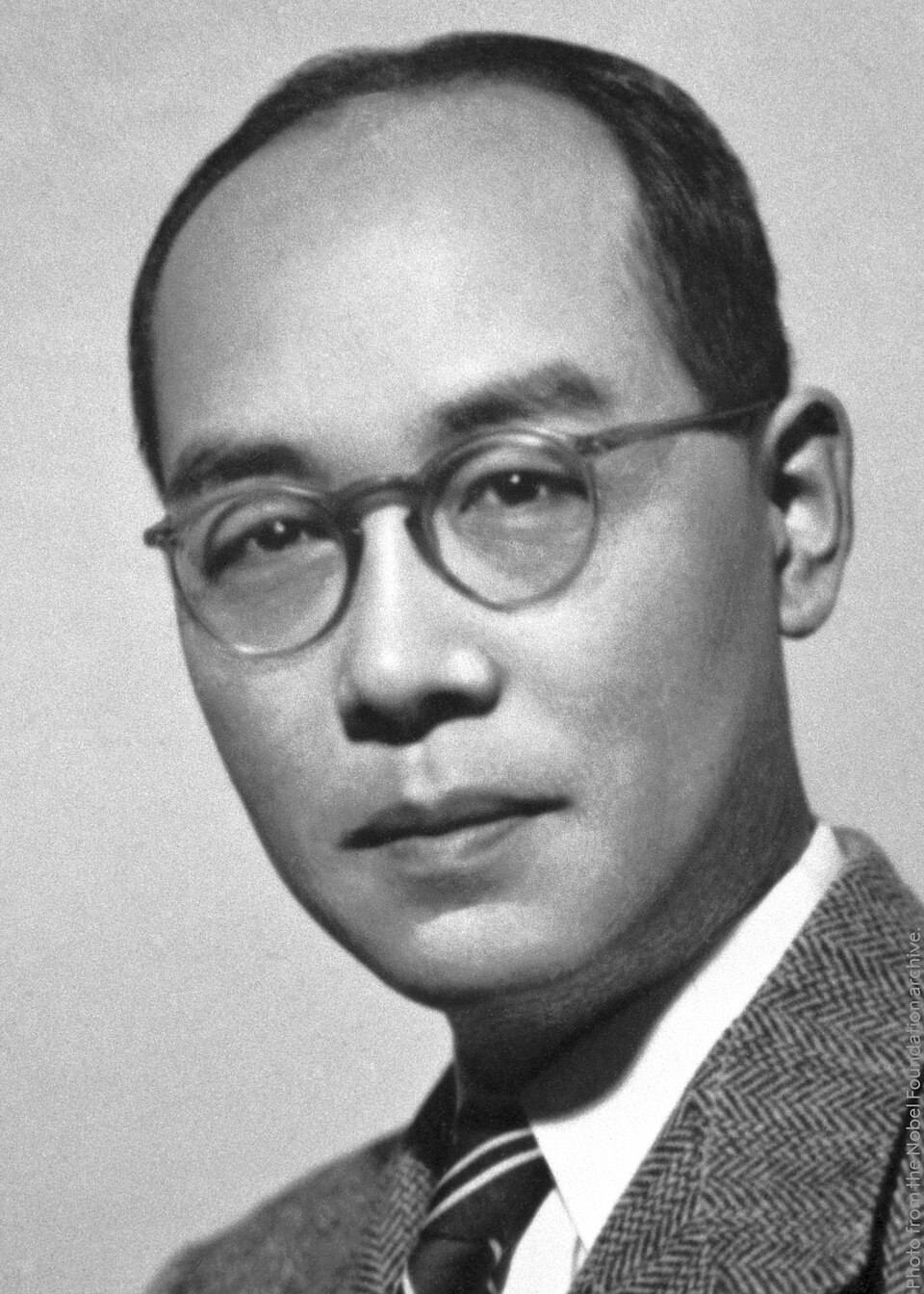
Hideki Yukawa
 Japan
Japanphysicist•theoretical physicist
Also known as: Hideki Ogawa
生日
January 23, 1907
星座
Aquarius
出生地
Azabu, Tokyo, Japan
年龄
74岁去世
身高
5 ft 6 in (168 cm)
简介
汤川秀树是一位日本理论物理学家,他取得了20世纪物理学最重要的突破之一。1935年,他预言了一种新的亚原子粒子——介子的存在,以解释原子核如何结合在一起。这项工作为他赢得了1949年的诺贝尔物理学奖,使他成为第一位获得诺贝尔奖的日本人。
汤川的介子理论为现代对强核力的理解奠定了基础,强核力是一种将原子核中的质子和中子结合在一起的基本相互作用。他的预言于1947年在π介子被发现后得到实验证实。如今,他的遗产通过京都大学汤川理论物理研究所得以传承,该研究所是理论研究的领先中心。
汤川是一位温和而富有哲学思想的人,同时也是一位公共知识分子。他于1955年签署了《罗素-爱因斯坦宣言》,呼吁核裁军。他在日本被尊为民族英雄和科学卓越的象征。他是第一位在任何领域获得诺贝尔奖的日本人,他的工作至今仍是粒子物理标准模型的基石。2025年,学术界举办了会议纪念他的介子理论提出90周年。他通过邮票、奖章和仍在积极从事研究的汤川研究所而持续受到纪念。
早年生活与背景
职业发展
职业生涯年表
公众形象与风格
名气与粉丝圈
Hideki Yukawa's public legacy is that of a revered national scientific figure, not a celebrity with a conventional fanbase. There is no formal fandom name, no organized fan clubs, and no documented grassroots fan campaigns. Instead, his memory is preserved through institutional honors: the Yukawa Institute for Theoretical Physics at Kyoto University, the Hideki Yukawa Chair in Theoretical Physics, and the renovation of his Kyoto residence by architect Tadao Ando. His Nobel Prize in 1949, the first for a Japanese citizen, made him a symbol of postwar Japanese achievement, and his advocacy for peace and disarmament further cemented his status as a moral leader. However, his fame is of a quiet, intellectual kind, celebrated in academic circles and national commemorations rather than through fan culture.
As of August 2026, iFANN's Global Fame Engine has evaluated Hideki Yukawa but he does not currently hold a placement in the published rankings, whether the Global Top 1,000 or any Top-100 scope list. His fame, while historically significant, does not translate into the contemporary global rankings that measure ongoing public engagement.
趣闻与传奇
Hideki Yukawa's original surname was Ogawa; he adopted the name Yukawa upon marrying in 1932. His classmate from elementary school through university, Sin-itiro Tomonaga, also won a Nobel Prize in Physics in 1965. Yukawa chose physics over mathematics after a high school teacher marked his creative proof incorrect, and he could not pursue experimental physics due to his failure to master glassblowing. His father initially considered him less gifted than his brothers and wanted him to attend technical college. In 1955, he signed the Russell-Einstein Manifesto alongside Einstein and Russell. He received numerous honors, including the Order of Culture, the Lomonosov Gold Medal, the Imperial Prize of the Japan Academy, and the Decoration of the Sacred Treasure. He was a member of the Japan Academy, a Foreign Member of the Royal Society, and a Foreign Associate of the National Academy of Sciences, and held honorary doctorates from the University of Paris and the University of Moscow.
A legendary moment in his legacy came in 2007 with the discovery of a cache of his unpublished manuscripts, dubbed "Yukawa's gold mine," which provided unprecedented insight into his thought processes. His deep attachment to Kyoto, despite his international career, is a recurring theme in his mythology, as is his time at the Institute for Advanced Study in Princeton, where he interacted with Albert Einstein. A 2025 article from the American Institute of Physics highlighted his interest in baseball, adding a humanizing touch to his image.
著名语录
“The theory of nuclear forces was my first love, and it was the subject of my first published paper.”
“We have to learn to think in a new way. We have to learn to ask ourselves, not what steps can be taken to give military victory to whatever group we prefer, for there no longer are such steps.”
“I was attracted to the study of nature because it seemed to me that the laws of nature are beautiful and simple.”
“The creative process in science is very similar to that in art. Both require imagination and intuition.”
家庭与个人生活
重要关系
恋情与交往史
汤川秀树于1932年与汤川寿美按照日本传统方式结婚。作为婚姻的一部分,他被收养到寿美家族,并将姓氏从小川改为汤川。寿美是汤川家族的女儿。他们育有二子,春树和贵晶。婚姻稳定而私密,专注于家庭和他的科学工作。汤川与寿美一直保持婚姻关系,直至1981年去世。没有任何其他恋爱关系的记录。截至2026年,他已去世,婚姻随其离世而终结。
- 已婚Sumi Yukawa1932 - 19811932年结婚;婚后汤川随妻子姓氏。育有二子。
逝世与身后事
逝世
September 8, 1981 (享年74岁)
逝世地点
Kyoto, Japan
死因
未知
Hideki Yukawa died on September 8, 1981, in Kyoto, Japan. The available records confirm the date and location of his passing but do not provide specific details regarding the official cause of death or any subsequent medical investigation. His final days were marked by no unusual events or public disputes, and his death was treated as a natural event without legal controversy. Tributes from the scientific community honored him as a pioneer in meson theory and quantum mechanics, focusing primarily on his enduring contributions to the understanding of the strong nuclear force. While the specific date and nature of his funeral or memorial service remain undocumented, his legacy continued through academic institutions.
Notable posthumous developments include the renovation of his former residence in Sakyo Ward, Kyoto, which served as his home for over two decades and was converted into a public multi-purpose facility by May 26, 2024. The academic community further recognized his stature with the establishment of the Hideki Yukawa Chair in Theoretical Physics, most recently awarded to Mayuko Yamashita in April 2026. The handling of his estate by the family is not detailed in the source material, though the primary documented legacy remains his status as Japan's first Nobel laureate in physics.
身价(遗产价值)
$2 Million
iFANN编辑团队估算
As a deceased Nobel laureate and university professor, Hideki Yukawa's estate value is estimated at $2 million, according to iFANN's editorial analysis. His lifetime earnings came primarily from academic salaries at Kyoto University and Columbia University, plus the Nobel Prize monetary award of approximately $30,000 in 1949 (equivalent to about $350,000 today). The estate generates revenue through royalties from his published works and scientific papers, as well as licensing of his name and image for educational materials and commemorative items such as stamps and medals. The Yukawa family manages the estate. The Yukawa Institute for Theoretical Physics at Kyoto University is a separate institutional entity that continues his academic legacy but does not generate personal income for the estate. Specific dollar figures for his estate are not publicly documented, but his papers receive thousands of citations annually on Google Scholar.
获奖 (4)
1949 · 物理学
Prediction of the existence of mesons
1949 · 文化荣誉
Contributions to physics
代表作
Meson theory (prediction of the pion)
1935 · Theoretical physicist
关键词
来源
速览
- 职业
- physicist, theoretical physicist
- 出生
- 1907-01-23
- 出生地
- Azabu, Tokyo, Japan
- 逝世
- 1981-09-08
- 逝世地点
- Kyoto, Japan
- 性别
- 男
- 配偶
- Sumi Yukawa
- 星座
- Aquarius
个人资料
- 全名
- Hideki Ogawa
- 身高
- 5 ft 6 in (168 cm)
- 配偶
- Sumi Yukawa
- 子女
- Haruki Yukawa, Takaaki Yukawa
- 教育
- Kyoto Imperial University (Master's, 1929); Osaka University (Ph.D., 1938)
常见问题
汤川秀树是如何预言介子的?
汤川秀树因何获得诺贝尔奖?
汤川秀树结婚了吗?
汤川秀树的身价是多少?
汤川秀树去世时多大年纪?
加入社区
位粉丝正在讨论