 Japan
Japan简介
早年生活与背景
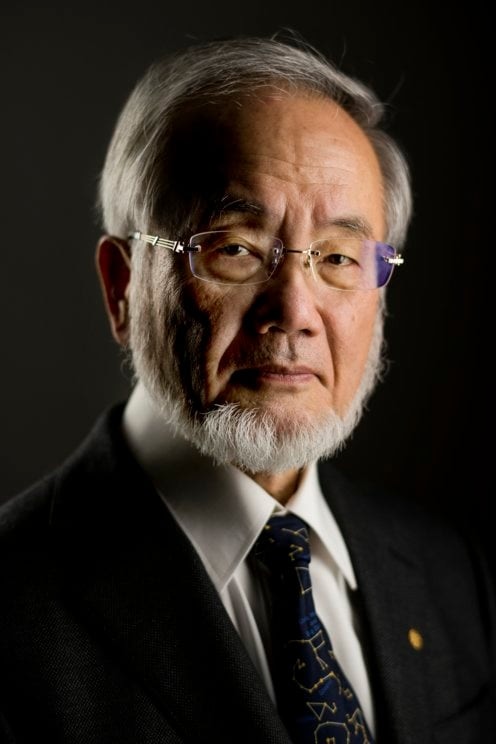
大隅于1945年出生在福冈,那时二战结束前半年。他在一个被稻田、溪流和山丘环绕的房子里长大,但作为一个体弱的孩子,他在战后食物匮乏时期遭受了营养不良。他母亲在生他后感染了结核病,卧床多年,最终因夏威夷的一位家庭朋友寄来的抗生素而康复。小学时,大隅收集昆虫并记忆星座,但这些只是童年的爱好。高中时,他加入了化学俱乐部,化学反应让他着迷。他于1963年进入东京大学学习化学,但很快发现这个领域缺乏吸引力,因为它已经很成熟。20世纪60年代初分子生物学的黄金时代吸引了他,于是他作为研究生加入了今堀和友的实验室。他于1967年获得理学学士学位,1974年获得理学博士学位,均来自东京大学。
1974年底,大隅移居纽约,在洛克菲勒大学担任诺贝尔奖得主杰拉尔德·M·埃德尔曼的博士后研究员。最初研究小鼠体外受精,后来转向利用酵母研究DNA复制起始,这让他接触了酵母研究。他于1977年返回日本,在东京大学担任安楽泰宏教授的研究助理。1986年被任命为讲师,1988年43岁时晋升为副教授,在等待了近20年后终于拥有了自己的小实验室。
职业发展
1988年开设自己的实验室后,大隅专注于酵母液泡的裂解功能。不久后,他利用光学和电子显微镜在酵母中发现了自噬。利用酵母系统,他对自噬缺陷突变体进行了遗传筛选。他的团队在第一次筛选中鉴定出15个对饥饿诱导自噬必需的基因,并开始克隆这些自噬相关(ATG)基因。这一发现开启了一个全新的生物学领域。1996年,他被任命为日本冈崎市国立基础生物学研究所教授。2004年,他在叶山的综合研究大学院大学兼任教授。2009年,他转为这两所机构的荣誉教授,并成为东京工业大学教授,领导细胞生物学研究单元。2012年,他获得京都基础科学奖。2015年获得加拿大盖尔德纳国际奖,随后于2016年因发现自噬机制获得诺贝尔生理学或医学奖。2017年,他获得突破奖生命科学奖。截至2026,他是东京科学大学创新研究所的教授,继续探索细胞如何自我回收。
职业生涯年表
公众形象与风格
名气与粉丝圈
Yoshinori Ohsumi is the 55th most famous person from Japan, a standing confirmed by the iFANN Global Fame Rankings in August 2026. This placement holds steady from the previous cycle, anchoring his global profile within a specific national context rather than a broad celebrity sphere. His fame stems not from viral moments or tabloid scandals, but from the quiet, seismic shift he caused in biological science. The iFANN system tracks this influence through a lens of enduring academic impact and sustained media coverage across research communities worldwide. While pop culture icons rely on fleeting attention, Ohsumi's recognition has deepened over decades, culminating in the 2016 Nobel Prize that cemented his legacy as the man who taught cells to eat themselves.
Despite this high-level recognition, there is no organized fandom for Yoshinori Ohsumi. No formal name exists for his supporters, nor are there fan rituals, birthday campaigns, or dedicated subreddits debating his theories. The "fans" of his work are the global scientific community and the general public benefiting from medical breakthroughs, yet they operate as an audience rather than a cult following. He remains a figure of profound respect rather than adoration, with his legend built entirely on verified milestones like the discovery of autophagy genes and the dispelling of misinformation regarding fasting cures. His story is one of solitary perseverance, where the only applause comes from peer-reviewed journals and the silence of a laboratory that finally made sense of cellular decay.
趣闻与传奇
The path to Yoshinori Ohsumi's success was paved with patience and simple observations. His breakthrough experiment involved starving yeast cells of nutrients and watching them devour their own contents, a method that revealed how cells maintain health by cleaning house. This simplicity belied the decades of effort required; Ohsumi did not have his own laboratory until he was 43 years old, nearly 20 years after returning to Japan from his postdoctoral fellowship. His motivation was rooted in a childhood memory: the words 'streptomycin' and 'aureomycin' stuck in his mind, though he didn't know what they meant then. His mother's recovery from tuberculosis through newly developed antibiotics left a lasting impression, driving him to choose research based on the precept 'doing what others have not done.' There was no shortcut to his success; it required constant and persevering efforts over decades.
Legends surrounding Ohsumi focus on the rigor of his science rather than folklore. The central iconic moment remains the identification of autophagy genes in the 1990s, which fundamentally reshaped the understanding of intracellular degradation. In October 2016, the Nobel Assembly awarded him the prize solely for this work, making him the first Japanese scientist to receive the award in physiology or medicine. Recent narratives also highlight the importance of accuracy; in late 2025 and early 2026, outlets clarified that Ohsumi remained the sole recipient of the 2016 prize, debunking false claims that he recommended fasting to cure cancer or Alzheimer's disease. These stories underscore a legacy defined by verified achievement rather than myth.
著名语录
“I was born in 1945 in Fukuoka, half a year before the end of the World War II... At that time, everyone in Japan was equally poor, and even food was not readily available.”
“I was a weak child who continually fell ill, a condition that was perhaps exaggerated by the malnourishment of the era.”
“I was brought up in a house surrounded by nature, with paddies, streams, hills and the sea all nearby.”
“I decided I wanted to work on that instead [molecular biology]... I was lucky, I think, because the early 1960s was the golden age of molecular biology.”
“We realized we had almost the entire pathway in our hands.”
“He said he chose scientific research as his career because of the precept he has always believed in, 'doing what others have not done.'”
家庭与个人生活
重要关系
恋情与交往史
大隅良典在与同为生物学家的Mariko Ōsumi在东京大学读研时相识。他们于1971年结婚,育有两子。Mariko是公开记录中他已知的唯一伴侣。截至2026年,大隅仍与Mariko Ōsumi保持婚姻关系。
- 已婚Mariko Ōsumi1971 - 至今现任在东京大学读研时相识;育有两子。
2026年薪资与身价
$5 Million
iFANN编辑团队估算
iFANN currently estimates Yoshinori Ohsumi's net worth at $5 Million as of 2026. This figure represents a curated editorial assessment of his financial standing derived primarily from major scientific prizes. The 2016 Nobel Prize in Physiology or Medicine contributed approximately 8 million Swedish kronor, or about $930,000 at the time. The 2017 Breakthrough Prize in Life Sciences added $3 million to his assets, while the 2012 Kyoto Prize provided about 50 million yen, or roughly $500,000. Beyond these accolades, Ohsumi has earned a steady academic salary as a professor at the University of Tokyo, the National Institute for Basic Biology, Tokyo Institute of Technology, and currently the Institute of Science Tokyo. Additional income sources include research grants and speaking engagements. No real estate holdings or other business ventures are publicly known.
获奖 (4)
2016 · 生理学或医学
Discoveries of mechanisms for autophagy
2017 · 生命科学
Elucidating the molecular mechanisms and physiological functions of autophagy
代表作
Discovery of autophagy mechanisms
1990s · 首席研究员
Nobel Prize in Physiology or Medicine
2016 · 桂冠奖
关键词
来源
速览
- 职业
- cell biologist
- 出生
- +1945-02-09
- 出生地
- Fukuoka, Japan
- 性别
- 男
- 配偶
- Mariko Ōsumi
- 星座
- Aquarius
个人资料
- 全名
- Yoshinori Ohsumi
- 配偶
- Mariko Ōsumi
- 子女
- 2 sons
- 教育
- University of Tokyo (B.Sci. 1967, D.Sci. 1974)
常见问题
大隅良典多大了?
大隅良典因何获得诺贝尔奖?
大隅良典结婚了吗?
大隅良典的身价是多少?
大隅良典发现了什么?
相似人物
加入社区
位粉丝正在讨论