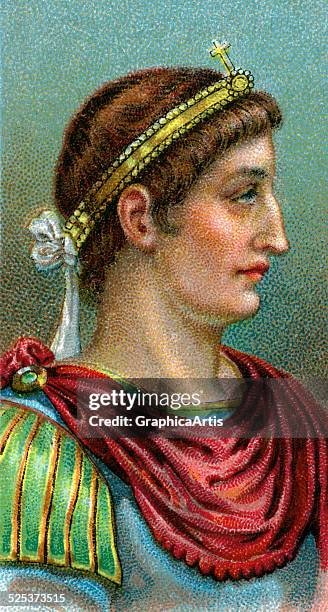
Constantine the Great
Roman emperor•military commander
Also known as: Constantine I, Flavius Valerius Constantinus
生日
February 27, 272
星座
Pisces
出生地
Naissus (modern-day Niš, Serbia)
年龄
65岁去世
简介
君士坦丁大帝是公元306年至337年的罗马皇帝,也是第一位皈依基督教的皇帝,这一决定改变了西方历史的进程。他将一个受迫害的信仰转变为帝国核心的力量,并建立了一个比罗马本身更持久的新首都。
他的统治因两项行动而被铭记。通过《米兰敕令》,他结束了基督徒的迫害,使他们的崇拜合法化,推动了罗马世界的基督教化;他还召集了尼西亚会议,试图为一个分裂的教会定义基督教教义。他也重新统一了在四帝共治下分裂的帝国,击败对手后独自统治。
公元330年,他将希腊城市拜占庭重建为君士坦丁堡(即现在的伊斯坦布尔),并将其作为首都。此后一千多年里,它一直是东罗马帝国和拜占庭帝国的所在地。君士坦丁在多个基督教传统中被封为圣徒,他被视为将罗马权力与基督教会融合的皇帝,这种结合塑造了中世纪欧洲及之后的世界。很少有古代统治者能留下如此深远的影响。
早年生活与背景
君士坦丁出生于罗马行省默西亚的奈苏斯城,他是军官克洛鲁斯·君士坦提乌斯和出身卑微的海伦娜的儿子。他的早年时光是在皇帝戴克里先统治下的东部行省度过的,在那里他接受了拉丁语和希腊语的正式教育,并接受了军事训练。他在帝国军队中担任护民官,参加了对抗波斯人和多瑙河边境的战役。
公元305年,戴克里先和他的共治皇帝马克西米安退位,君士坦提乌斯晋升为西部奥古斯都。君士坦丁获准前往高卢与父亲会合,在那里他参加了在不列颠对抗皮克特人的战役。公元306年,君士坦提乌斯在埃博拉库姆(今约克)去世,忠于他父亲的军队立即拥立君士坦丁为皇帝。他当时34岁,从未被正式指定为继承人,这为二十年的内战埋下了伏笔。
职业发展
君士坦丁花了接下来的十八年时间征战,以巩固和扩大自己的权力。在击败莱茵河上的法兰克部落后,他进军意大利,并于公元312年在米尔维安大桥与对手马克森提乌斯对峙。根据传统,君士坦丁看到天空中有一个十字架异象,上面写着“凭此标记,你必征服”。他将基督教符号用在士兵的盾牌上,并取得了决定性胜利。次年,他在米兰与李锡尼会面,颁布了《米兰敕令》,授予所有公民(包括基督徒)宗教自由。
到公元324年,君士坦丁击败了李锡尼,重新统一了罗马帝国,由一人统治。他立即转向教会事务,于公元325年召集尼西亚会议,以解决阿里乌斯争议并制定《尼西亚信经》。公元330年,他在拜占庭旧址上建立新都,命名为君士坦丁堡。这座城市规模宏大,拥有广场、赛马场和教堂,迅速成为东部帝国的政治和文化中心。君士坦丁在波斯边境征战中度过了最后几年,并于公元337年在尼科米底亚去世,临终前接受了洗礼。
职业生涯年表
公众形象与风格
君士坦丁被教会历史学家如尤西比乌斯描绘为理想的基督教皇帝,他们赞美他的虔诚和神的眷顾。异教作家则更持批评态度,视他为篡位者,耗尽了国库并引入了东方专制。在艺术中,他通常被描绘成年轻、无须、戴着王冠的形象,象征着他的权威以及对四帝共治风格的突破。他在君士坦丁堡的雕像手持十字架和长矛。现代历史学家视他为务实的统治者,利用基督教来统一帝国,而他个人的信仰仍存争议。他在东正教、天主教和东方正统教会中被封为圣徒,节日在5月21日。
名气与粉丝圈
Constantine the Great ruled an empire that stretched from Britain to the Middle East, yet his fame today is measured not in territories but in the enduring weight of his name. The iFANN Global Fame Engine has evaluated his legacy, and as of August 2026, he holds no placement in the published rankings, neither in the Global Top 1,000 nor in any Top-100 scope list. This is not a slight; it is a consequence of a fame that operates on a different scale, one built over seventeen centuries rather than a single season. His renown is diffuse, woven into the fabric of Western civilization, but it does not translate into the kind of concentrated, contemporary attention that ranking systems capture.
His audience is not a fandom in any modern sense. There is no formal name for those who study him, no fan conventions, no coordinated campaigns. What exists is something older and more profound: a religious veneration. The Eastern Orthodox Church honors him as a saint, and his feast day, shared with his mother Helena, is celebrated with liturgical services. Beyond that, he draws a steady stream of history enthusiasts, documentary viewers, and scholars, people who engage with his life through books, videos, and debate. They are a diffuse community, united by curiosity rather than a shared label. The liveliest ongoing argument among them concerns the authenticity of his conversion: was it genuine faith or political calculation? That question, unresolved after centuries, may be the closest thing to a fan ritual he has.
趣闻与传奇
Constantine was the first Roman emperor to be baptized as a Christian, though he delayed the rite until he was on his deathbed, a common practice at the time. He is credited with commissioning the first copies of the Bible for use in Constantinople, ordering fifty manuscripts from Eusebius of Caesarea. The Donation of Constantine, a forged document purporting to grant the Pope temporal authority over the Western Roman Empire, was used for centuries to justify papal power. Constantine never visited Rome after 326, preferring his new eastern capital. His mother Helena is credited with discovering the True Cross during a pilgrimage to Jerusalem. The Arch of Constantine in Rome, completed in 315, commemorates his victory at the Milvian Bridge and incorporates reliefs from earlier emperors.
The most famous legend of his reign is the vision before the Battle of the Milvian Bridge in 312: according to the story, he saw a cross of light in the sky with the words “In this sign, conquer.” The tale, told by the historian Eusebius, remains a cornerstone of his Christian legacy, even though the earliest accounts describe a dream rather than a daytime vision. Another enduring story holds that he founded Constantinople on the site of ancient Byzantium, creating a “New Rome” that would outlast the Western Empire by nearly a thousand years. His convening of the Council of Nicaea in 325, which produced the Nicene Creed, is also retold as the moment an emperor first shaped church doctrine on a universal scale.
著名语录
“In hoc signo vinces.”
“I am convinced that the greatest good that can befall men is the knowledge of the divine.”
“Let us have nothing in common with the detestable Jewish crowd.”
“The Catholic Church is the one true church, and outside it there is no salvation.”
家庭与个人生活
君士坦丁的母亲海伦娜是来自比提尼亚德雷帕努姆的希腊妇女。他的父亲克洛鲁斯·君士坦提乌斯是成为皇帝的罗马将军。当君士坦提乌斯与马克西米安的女儿狄奥多拉结婚以确保政治联盟时,海伦娜被离婚或休弃。君士坦丁一生与母亲关系密切,在他掌权后,他授予她奥古斯塔的头衔,并派她前往圣地朝圣。他的第一任妻子米内维娜在公元307年左右去世或被离婚;她是他的长子克里斯普斯的母亲。公元307年,君士坦丁与前皇帝马克西米安的女儿弗拉维娅·马克西玛·福斯塔结婚。他与福斯塔生了三个儿子:君士坦丁二世、君士坦提乌斯二世和康斯坦斯,他们后来都成为皇帝。这个家庭被悲剧笼罩:克里斯普斯于公元326年因通奸指控被处决,福斯塔不久后也被杀,可能是君士坦丁亲自下令。原因至今仍有争议。
重要关系
君士坦丁的母亲海伦娜(后来的圣海伦娜)对他影响深远,并因发现真十字架而受到赞誉。他的共治皇帝后来成为对手的李锡尼在《米兰敕令》后与他分享权力,直到被击败。他的儿子克里斯普斯在神秘情况下被处决,他的第二任妻子福斯塔不久后去世。神学家凯撒利亚的尤西比乌斯撰写了君士坦丁的传记,塑造了他的基督教遗产。他的儿子君士坦丁二世、君士坦提乌斯二世和康斯坦斯继承了他的位置,瓜分了帝国。
恋情与交往史
君士坦丁大约在公元300年与米涅维娜结婚,但关于她的信息很少。她生下了他的第一个儿子克里斯普斯,并在307年去世或离婚。307年,君士坦丁与前皇帝马克西米安的女儿弗拉维亚·马克西玛·福斯塔结婚,以巩固他的政治地位。这段婚姻育有三个儿子和两个女儿。326年,君士坦丁下令处死克里斯普斯,据称是因为他与福斯塔通奸。不久之后,福斯塔也被处死,可能是在蒸汽浴室中被窒息而死。具体细节仍不清楚,但这些事件给皇室家族蒙上了阴影。截至2026年,君士坦丁已故。
- 已婚Minervina300 - 307第一任妻子,克里斯普斯的母亲;约307年去世或离婚。
- 已婚Flavia Maxima Fausta307 - 326第二任妻子,皇帝马克西米安之女;326年被处死。
逝世与身后事
逝世
May 22, 337 (享年65岁)
逝世地点
Nicomedia, Bithynia, Roman Empire
死因
Fever or severe illness
The Roman Senate officially deified Constantine, granting him the title Divus Constantinus and issuing coinage bearing his image alongside the inscription DEO ET DOMINO CONSTANTINO MAGNO. He passed away on May 22, 337 AD at a villa in Nicomedia after falling ill with a severe fever while preparing for a campaign against the Persians. Ancient chronicles by Eusebius and Aurelius Victor describe a natural decline following a long reign, noting that he received baptism from Eusebius of Nicomedia shortly before his death. Legends suggesting poisoning by political rivals or family members exist but are widely regarded as baseless fabrications lacking contemporary evidence. Christian institutions immediately began honoring him as a saint, venerating him in the Eastern Orthodox and Catholic Churches as Saint Constantine the Great, Equal-to-the-Apostles.
The funeral took place shortly after his death in Constantinople within the Church of the Holy Apostles, a mausoleum he had constructed specifically for this purpose. High-ranking clergy, the imperial court, and military leaders attended the procession, which included a eulogy delivered by bishops. His sons, Constantine II, Constantius II, and Constans, were present and subsequently divided the empire among themselves following traditional Roman practice. Posthumous recognition has been extensive, spanning thousands of books, films, and academic studies including the documentary Constantine the Great - Emperor of the New Rome . Annual feast days were established to commemorate his life and death, celebrated on May 22 or June 3 in the Julian calendar.
身价(遗产价值)
作为4世纪的皇帝,君士坦丁掌控了整个罗马帝国的国库,其规模在古代是巨大的。他的财富来自皇室领地、税收、贡品和战利品。他资助了大规模的建筑项目,包括君士坦丁堡的城墙、广场和教堂,以及罗马的君士坦丁凯旋门。他还将财富重新分配给基督教会,赐予土地和免税权。他去世后,财产传给了他的儿子们,但无法计算出现代意义上的身价。
奖项与荣誉
View 7 records, honours and achievements代表作
Edict of Milan
313 · Issuer
Council of Nicaea
325 · Convener
Founding of Constantinople
330 · Founder
关键词
速览
- 职业
- Roman emperor, military commander
- 出生
- February 27, 272
- 出生地
- Naissus (modern-day Niš, Serbia)
- 逝世
- May 22, 337
- 逝世地点
- Nicomedia (modern-day İzmit, Turkey)
- 性别
- 男
- 配偶
- Minervina, Flavia Maxima Fausta
- Children
- Crispus, Constantine II, Constantius II, Constans
个人资料
- 全名
- Flavius Valerius Constantinus
- 配偶
- Minervina, Flavia Maxima Fausta
- 子女
- Crispus, Constantine II, Constantius II, Constans
常见问题
君士坦丁大帝是谁?
君士坦丁大帝最重要的成就是什么?
君士坦丁大帝出生于何时何地?
为什么君士坦丁大帝重要?
君士坦丁大帝何时去世?
加入社区
位粉丝正在讨论