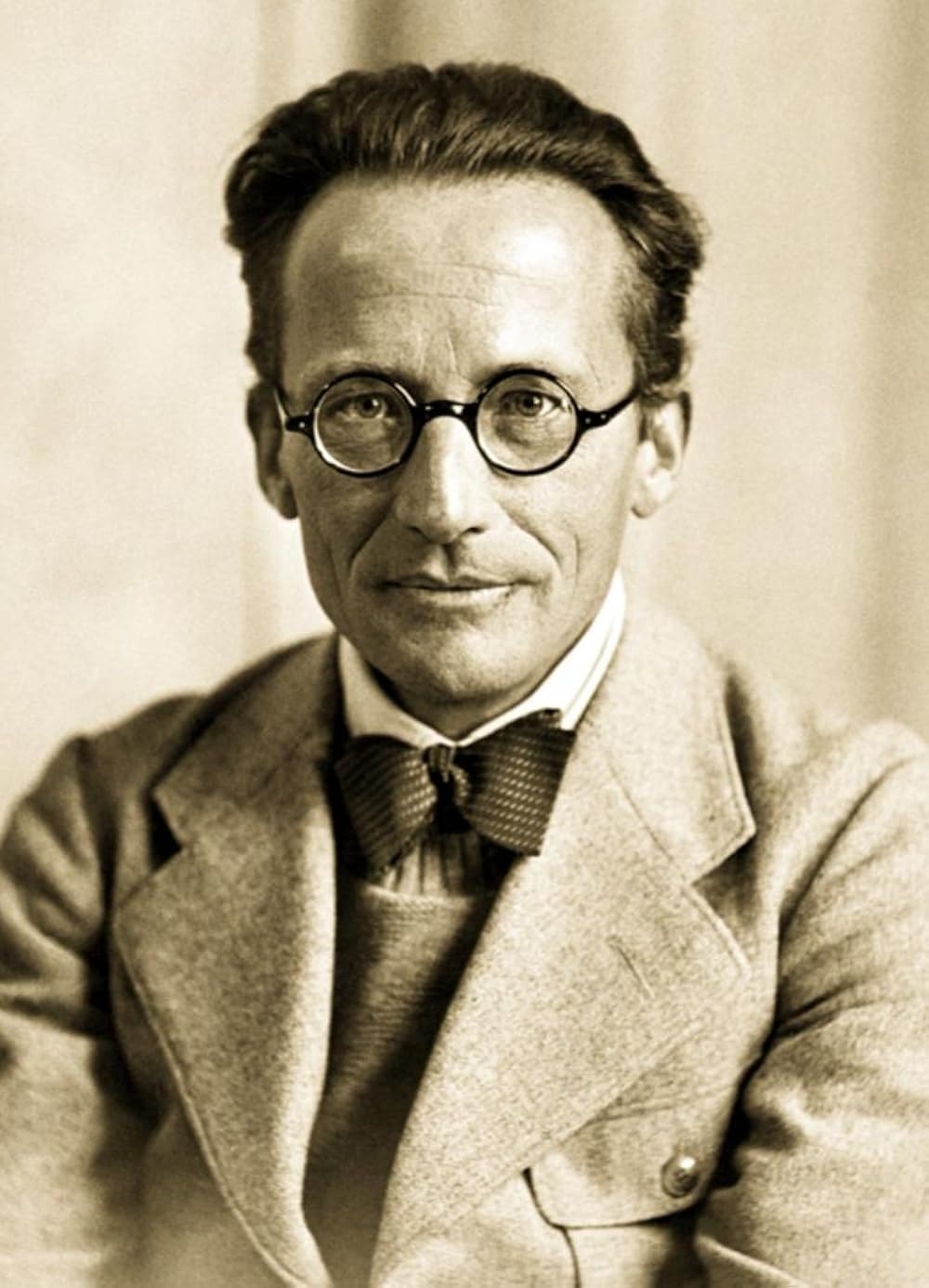
Erwin Schrödinger
 Austria
physicist•theoretical physicist•non-fiction writer
生日
August 12, 1887
星座
Leo
出生地
Vienna, Austria
年龄
73岁去世
简介
埃尔温·薛定谔是一位奥地利理论物理学家,他的工作从根本上重塑了现代物理学。他最出名的是薛定谔方程,这是量子力学的核心数学框架,以及他创造了“量子纠缠”一词。1933年,他因发现新的原子理论的富有成效的形式而与保罗·狄拉克分享了诺贝尔物理学奖。他的思想实验薛定谔的猫已成为量子怪异性的文化速记。在物理学之外,他1944年的著作《生命是什么?》探讨了遗传的物理基础,启发了一代分子生物学家。如今,他的思想仍然是量子理论的核心,他的名字出现在从教科书到电视节目的各个地方。
早年生活与背景
薛定谔在维也纳一个富裕的家庭长大。他的父亲经营着一家植物研究所并教授植物学,而他的母亲来自一个学术家庭。他在家接受一位私人导师的教育直到11岁,然后就读于著名的皮亚里斯特中学。在维也纳大学,他在弗兰茨·埃克斯纳和弗里德里希·哈森厄尔的指导下学习物理学和数学,并于1910年以关于固体热扩散的论文获得了博士学位。
毕业后,他在大学理论物理研究所担任助理。第一次世界大战期间,他曾在意大利前线担任炮兵军官,通过阅读战壕里的期刊来跟进物理学。战后,他在耶拿、斯图加特和布雷斯劳担任短期职务。1921年,他移居苏黎世大学,在那里他开始深入研究量子理论,这最终导致了他的突破。
职业发展
薛定谔的决定性时刻发生在1926年,当时他发表了一系列介绍波动力学的论文。薛定谔方程用粒子的一种基于波的描述取代了旧的量子模型,统一了德布罗意等人的早期工作。这项发现为他赢得了1933年诺贝尔物理学奖,与保罗·狄拉克共享。
1935年,他发表了一篇关于他称之为量子纠缠的论文,描述了粒子如何在广阔的距离上保持连接。同年,他设计了薛定谔的猫思想实验,以突出叠加态的荒谬性。在1938年逃离纳粹占领的奥地利后,他在都柏林高等研究院度过了17年,期间他撰写了《生命是什么?》(1944年),这本书探讨了物理学如何解释遗传,并影响了詹姆斯·沃森和弗朗西斯·克里克。他于1956年回到维也纳,五年后在那里去世。
职业生涯年表
公众形象与风格
薛定谔被铭记为一位富有远见的物理学家,他优雅的方程成为了量子力学的基石。他的公众形象是一位才华横溢、古怪的思想家,横跨科学与哲学领域。薛定谔的猫悖论使他超越了学术界,家喻户晓,出现在电影、电视节目和表情包中。在科学界,他因其广度和原创性而受到尊重,尽管他的个人生活以及后来的虐待指控引发了争议。没有有组织的粉丝群体,但他的名字在科学爱好者中承载着敬畏和好奇的混合体。
名气与粉丝圈
Erwin Schrödinger's fame rests not on fan clubs or chart-topping campaigns, but on the enduring power of his ideas. In the century since he formulated his wave equation, his name has become synonymous with quantum mechanics itself, and his cat thought experiment has permeated global culture in ways few scientific concepts ever have. Yet, in the strict sense of modern fandom, Schrödinger has no organized following. There is no formal or informal fandom name, no coordinated fan projects, no birthday billboards or charity drives. His audience is diffuse, physicists, philosophers, students, and the curious, united by intellectual engagement rather than communal identity. The closest analogue to fan rituals are the annual commemorations of his work, such as the 2026 centenary of his equation, celebrated in academic circles worldwide.
iFANN's Global Fame Engine has evaluated Erwin Schrödinger, but as of August 2026, he does not hold a placement in the published rankings, neither in the Global Top 1,000 nor in any Top-100 scope list. This absence reflects the engine's focus on contemporary media presence and active fandom, categories in which a deceased physicist, however monumental, does not compete. His fame is of a different order: enduring, cultural, and academic, rather than measured by current search trends or streaming data. Nevertheless, his thought experiment's metaphorical reach, evident in phrases like "Schrödinger's [X]" used in politics and tech, ensures his name remains a fixture in public discourse, even if the rankings do not capture it.
趣闻与传奇
Schrödinger wrote poetry throughout his life and published a collection, Poems, in 1949. He was an avid mountaineer and hiker, often taking long walks in the Alps. He spoke several languages, including English, French, and Italian. His cat paradox was originally meant as a criticism of the Copenhagen interpretation, not an endorsement. The 1989 allegations of sexual abuse of minors, made public by biographers, complicated his legacy. He also had a strong interest in Hindu philosophy, particularly the Vedanta school, and incorporated its ideas into his worldview.
The most iconic legend associated with Schrödinger is the cat thought experiment, proposed in a 1935 paper as a reductio ad absurdum. It has since become a universal cultural metaphor, spawning countless references in media and even inspiring the term "Schrödinger's kittens" for entangled states in quantum physics. Another foundational story is his 1944 book What Is Life?, which speculated on the physical basis of heredity and is credited with inspiring Francis Crick and James Watson to pursue molecular biology. The 1926 centenary of his equation, marked in 2026, further cemented his legacy as a pioneer whose work continues to shape science.
著名语录
“The task is not so much to see what no one has yet seen, but to think what nobody has yet thought about that which everybody sees.”
“I don't like it, and I'm sorry I ever had anything to do with it.”
“The consciousness of the world is a thing that we cannot understand; we have to accept it as a fact.”
“The present is the only thing that has no end.”
家庭与个人生活
薛定谔于1920年与安娜玛丽·贝尔特尔结婚;他们育有一女伊娃,出生于1921年。这段婚姻不同寻常:薛定谔与一位名叫希尔德·马奇的前女学生长期保持关系,希尔德于1934年生下了他的女儿露丝。安娜玛丽也与希尔德的丈夫、物理学家亚瑟·马奇有染。这四人时断时续地同居,这种安排在牛津引起了丑闻,并导致薛定谔离开了牛津。他与两个女儿关系都很亲近,露丝后来成为维也纳的一名图书管理员。
重要关系
薛定谔最著名的合作者是保罗·狄拉克,他与狄拉克共同获得了1933年诺贝尔奖。他与阿尔伯特·爱因斯坦进行了广泛的通信,爱因斯坦对量子力学持怀疑态度,并帮助激发了猫的悖论。在都柏林,他与约翰·辛格以及高等研究院的其他物理学家一起工作。他的著作《生命是什么?》直接影响了詹姆斯·沃森、弗朗西斯·克里克和莫里斯·威尔金斯,他们认为这本书是他们发现DNA结构的催化剂。
恋情与交往史
薛定谔于1920年与安娜玛丽·贝尔特尔结婚。他们的婚姻是开放且非传统的。在20世纪30年代初,他开始与一位名叫希尔德·马奇的前女学生有染,希尔德于1934年生下了他的女儿露丝。与此同时,安娜玛丽与希尔德的丈夫、物理学家亚瑟·马奇有染。这四位成年人有时同居,这种情况震惊了牛津的同事,并导致薛定谔辞去了他的奖学金。尽管存在这些复杂情况,薛定谔直到1961年去世前一直与安娜玛丽保持婚姻关系。他与两个女儿都保持着亲密关系,希尔德在几十年里一直是他生活的一部分。
- 已婚Annemarie Bertel1920 - 1961非传统婚姻;双方都有婚外情。
- 曾交往Hilde March1932 - 1961长期情妇;露丝的母亲。
逝世与身后事
逝世
January 4, 1961 (享年73岁)
逝世地点
Vienna, Austria
死因
pulmonary tuberculosis
Erwin Schrödinger spent his final months in the care of medical professionals at the University Clinic in Vienna, where he had returned to Austria after years of exile in Ireland and England. The Austrian theoretical physicist passed away on January 4, 1961, at the age of seventy-three, having battled pulmonary tuberculosis for many years, a condition exacerbated by his long-term smoking habit. Public reaction was marked by widespread mourning within the scientific community, highlighted by a biographical memoir published by the Royal Society that honored his contributions to wave mechanics and quantum theory while acknowledging his later philosophical inquiries into biology. The funeral arrangements were conducted privately, with Schrödinger cremated in Vienna before his ashes were interred in the family grave at Hietzing Cemetery.
Close colleagues, family members, and representatives from the Austrian Academy of Sciences attended the service, though the event remained a private gathering rather than a large public state ceremony. In the posthumous era, his legacy has been sustained through continued reprints of his works, including the prescient 1944 book What Is Life?, which remains cited for its influence on the discovery of DNA structure. Numerous institutions have established scholarships and foundations in his name, such as the Erwin Schrödinger International Institute for Mathematical Physics in Vienna, ensuring his intellectual property rights continue to generate royalties for his heirs.
获奖 (1)
薛定谔因其波动力学表述而荣获1933年诺贝尔物理学奖,与保罗·狄拉克共享。他还在1947年获得了马克斯·普朗克奖章,这是德国最高的物理学荣誉之一。他于1949年当选为英国皇家学会会员,并获得了都柏林大学、爱丁堡大学和维也纳大学等大学的荣誉博士学位。
1933 · 物理学
Wave mechanics formulation of quantum theory
代表作
Schrödinger equation
1926 · Creator
Schrödinger's cat
1935 · Creator
Quantum entanglement
1935 · Coined term
What Is Life?
1944 · 作者
关键词
速览
- 职业
- physicist, theoretical physicist, non-fiction writer
- 出生
- +1887-08-12
- 出生地
- Vienna, Austria
- 逝世
- +1961-01-04
- 逝世地点
- Vienna, Austria
- 性别
- 男
- 配偶
- Annemarie Schrödinger
- 星座
- Leo
个人资料
- 全名
- Erwin Rudolf Josef Alexander Schrödinger
- 配偶
- Annemarie Schrödinger
- 子女
- Eva Schrödinger, Ruth Georgi
- 教育
- University of Vienna (PhD, 1910)
常见问题
埃尔温·薛定谔因何出名?
Erwin Schrödinger 是何时获得诺贝尔奖的?
薛定谔的猫的思想实验是什么?
什么是薛定谔方程?
厄温·薛定谔的个人生活是怎样的?
加入社区
位粉丝正在讨论