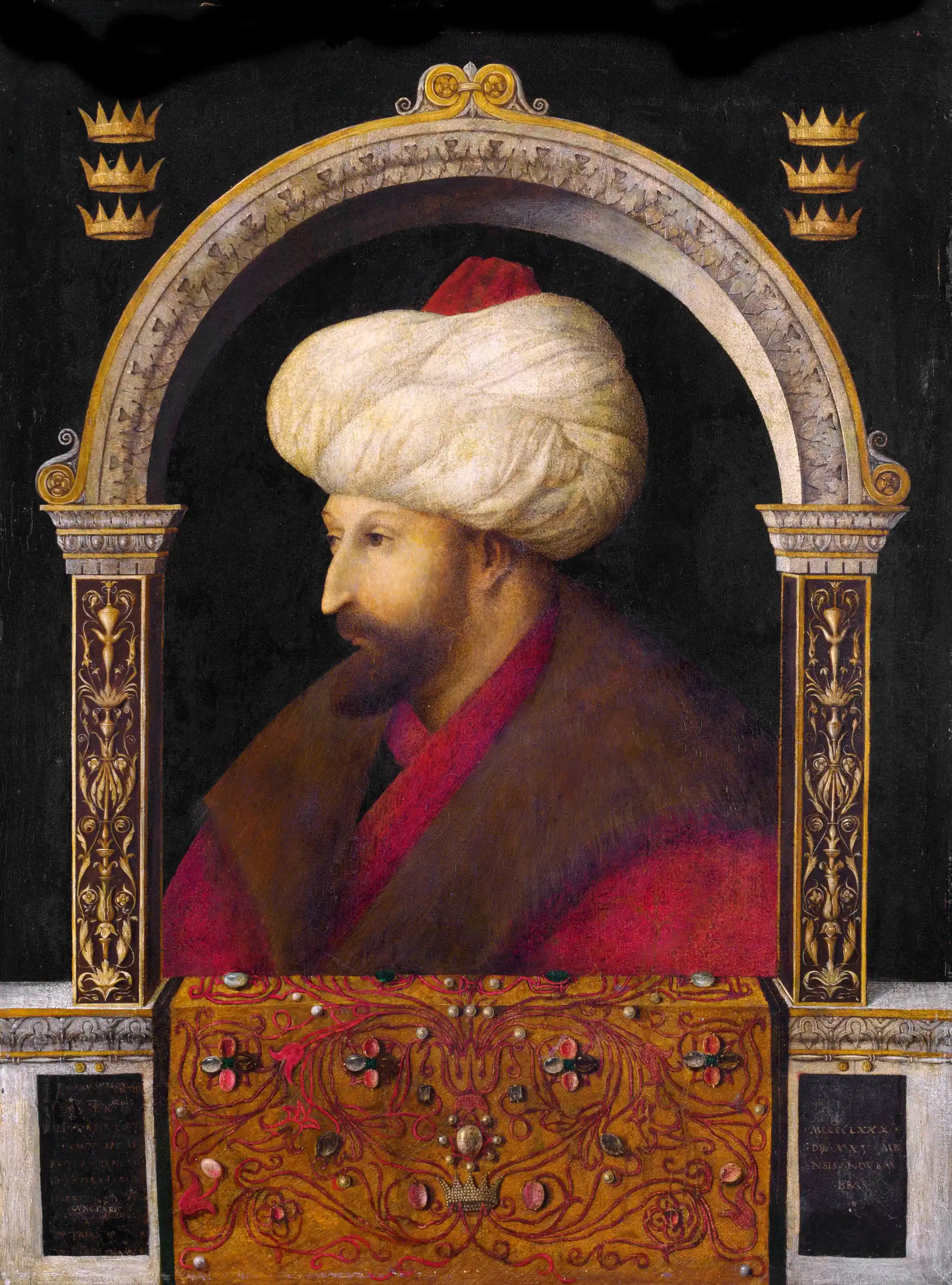
Mehmed II
Also known as: Mehmed the Conqueror, Fatih Sultan Mehmed, Kayser-i Rum
生日
March 30, 1432
星座
Aries
出生地
Edirne, Ottoman Empire
年龄
49岁去世
身高
5 ft 7 in (170 cm)
简介
Mehmed II是一位奥斯曼苏丹、诗人兼征服者,曾两次统治,分别是在1444年至1446年以及1451年至1481年去世。他最著名的事迹是在21岁时于1453年征服君士坦丁堡,这结束了拜占庭帝国,并为他赢得了罗马凯撒的称号。这一关键成就将君士坦丁堡转变为奥斯曼帝国的首都,并极大地扩展了奥斯曼帝国在东南欧和安纳托利亚的影响力。除了军事才能,Mehmed还是一位艺术和科学的赞助人,他以Avni的笔名写诗,并改革了奥斯曼的法律体系。他今天被誉为征服者Mehmed,这个称号反映了他重塑中世纪世界的巨大成功。他的遗产体现在伊斯坦布尔,他将这座城市重建为一个繁荣的帝国中心,以及以他名字命名的各种纪念碑和地区。
早年生活与背景
Mehmed bin Murad Han于1432年3月30日出生在奥斯曼帝国当时的首都埃迪尔内。他是苏丹Murad II和奴隶妃子Hüma Hatun的儿子。尽管他是第三个儿子,但他的哥哥Ahmed和Alaeddin早逝,使他成为奥斯曼王位的继承人。他早年的生活特点是接受了极其严格和全面的教育,旨在为他成为领导者做准备。他曾受教于一群杰出的学者,包括Molla Gürani、Molla Hüsrev、George Amiroutzes和Ciriaco d'Ancona。Molla Gürani以严厉的纪律塑造年轻的王子,而Molla Hüsrev则教授神学和伊斯兰教法。希腊学者George Amiroutzes和意大利人文主义者Ciriaco d'Ancona拓宽了Mehmed的视野,向他介绍了西方哲学、地理以及亚历山大大帝和尤利乌斯·凯撒等人物的军事和政治生活,这极大地激发了他的雄心。他的课程包括深入学习《古兰经》、法学、哲学和军事战略,以及语言。到11岁时,Mehmed已能流利地使用土耳其语、阿拉伯语、波斯语、希腊语、拉丁语和希伯来语,他还培养了早期对诗歌的兴趣,并以Avni为笔名写作。
年仅11岁的Mehmed被任命为阿马西亚的总督,这是奥斯曼王子传统的职位,也是未来统治者重要的训练场。1444年,年仅12岁的他,其父苏丹Murad II做出惊人决定退位,导致Mehmed首次登上苏丹宝座。这次最初的统治从1444年到1446年,立即陷入危机。一场由波兰国王Władysław III和匈牙利国王John Hunyadi领导的重大欧洲十字军东征威胁着帝国。Mehmed的年轻和缺乏经验在应对危机时显露出来,促使他的父亲从退休状态返回指挥奥斯曼军队。Murad II在1444年11月的瓦尔纳战役中率军取得了决定性胜利。在一段政治不稳定和禁卫军骚乱的时期后,Murad II于1446年正式重登王位。Mehmed随后被送往马尼萨担任总督,在那里他继续接受密集的教育和军事训练,进一步成熟,为承担领导职责做准备。
1451年苏丹Murad II去世后,年仅19岁的Mehmed第二次登上奥斯曼王位。他作为苏丹的第一个举动是无情地展示权力:他下令谋杀他同父异母的婴儿弟弟Küçük Ahmed。这一残酷的措施是为了消除任何潜在的王位竞争者,虽然残忍,但后来成为奥斯曼继承政策中一个标准但 grim 的方面。
职业发展
Mehmed的决定性成就在1453年到来,经过53天的围攻,他征服了君士坦丁堡。他于1452年下令建造Rumeli Hisarı以封锁博斯普鲁斯海峡,切断了海上通道。1453年5月29日,他的军队攻破了城墙,Mehmed进入了这座城市,将圣索菲亚大教堂改建为清真寺,并自称为罗马凯撒。他重新安置了这座大部分被遗弃的城市,并将其设为奥斯曼帝国的首都——伊斯坦布尔。
在接下来的二十年里,Mehmed发动了无情的战役。他征服了塞尔维亚(1454-1456年)、摩里亚(1458-1460年)、特拉比松帝国(1461年)和波斯尼亚(1463年)。与威尼斯的长期战争(1463-1479年)以《君士坦丁堡条约》结束,奥斯曼帝国获得了对Negroponte、Lemnos和阿尔巴尼亚的控制权。1468年,他征服了Karaman,统一了安纳托利亚。在1473年的Otlukbeli战役中,他决定性地击败了Aq Qoyunlu联盟。他于1475年使克里米亚汗国成为附庸,并于1479年占领了阿尔巴尼亚的Shkodër。1480年,他的军队占领了意大利的Otranto,为奥斯曼帝国在欧洲建立了立足点,尽管在去世后被放弃。
在国内,Mehmed编纂了Kanunname法典,中央集权化国家,并推广了devşirme制度。他委托建造了Fatih清真寺建筑群和托普卡帕宫,并创立了Sahn-ı Seman Medrese,这是第一所奥斯曼大学。他邀请了Gentile Bellini等艺术家,后者于1480年为他绘制了肖像,并赞助了Kritovoulos等历史学家。他的统治将奥斯曼帝国转变为一个全球强国。
职业生涯年表
公众形象与风格
穆罕默德二世被誉为杰出的军事战略家和博学的知识分子。在土耳其历史中,他被尊为征服者法提赫·苏丹·穆罕默德,实现了征服君士坦丁堡的伊斯兰预言。他的形象融合了冷酷的战士与文艺复兴时期的王子:他可以下令处决对手,随后与希腊学者讨论哲学。西方历史学家常将他描绘成一位令人敬畏且开明的统治者,注意到他对帝国中基督徒和犹太人的宽容以及对艺术的赞助。他的绰号“征服者”被普遍使用,贝利尼为他绘制的肖像成为标志性作品。奥斯曼历史的爱好者称赞他的雄心与远见,而一些批评者则指出他战役的残酷以及强制迁徙人口的行为。他的遗产在现代土耳其仍是骄傲之源,他的名字被用于桥梁、大学和地区。
名气与粉丝圈
The enduring appeal of Mehmed II transcends the typical boundaries of modern fandom, rooted instead in a deep, state-sponsored reverence that has persisted for over five centuries. Unlike contemporary celebrities who rely on social media trends or fan clubs, his admirers are found in historical societies, academic circles, and the Turkish nation itself, which commemorates his conquest of Constantinople with grand annual ceremonies rather than digital hashtags. There is no formal name for this collective group of enthusiasts; the public's devotion manifests through cultural preservation and educational tributes rather than organized campaigns or merchandise drives. While fictional portrayals like the Netflix drama *Mehmed* have sparked renewed interest, they reflect engagement with a dramatized narrative rather than a grassroots movement dedicated to the historical figure. His legacy remains a subject of intense study and national pride, characterized by a solemn respect for his role in ending the Byzantine Empire and shaping the modern world. Despite this massive global influence and the sheer volume of literature written about him, iFANN's Global Fame Engine has evaluated this person, but they do not currently hold a placement in the published rankings (Global Top 1,000 or a Top-100 scope list). This absence from the current charts reflects the unique nature of his fame as a historical monarch rather than a fluctuating celebrity metric.
趣闻与传奇
Mehmed wrote poetry under the pen name Avni, meaning the Helper, and his divan collection survives to this day. He was fluent in six languages: Turkish, Arabic, Persian, Greek, Latin, and Hebrew, reportedly memorizing works by Homer and Aristotle. His portrait by Gentile Bellini, painted in 1480, stands as one of the few contemporary images of any Ottoman sultan. The sultan maintained a personal library filled with philosophy, geography, and science texts, often debating religious topics with scholars of different faiths. He also possessed a fascination with automata, commissioning engineers to create moving statues and clocks for his palace. Beyond these facts, the most legendary moment in his life is the Fall of Constantinople on May 29, 1453. At just 21 years old, he led a siege against massive walls using giant cannons, including the famous 'Basilica' cast by Urban the Hungarian. Upon entering the city, folklore says he rode directly to Hagia Sophia to pray before ordering protection for refugees, though accounts of the subsequent looting vary. Another enduring story surrounds his death on May 3, 1481, at Hunkar Cayiri. While official records cite natural causes, centuries of speculation suggest assassination or poisoning due to the political instability and succession struggles among his sons. These narratives have evolved into cultural myths celebrated annually by the Turkish state.
著名语录
“I am the emperor of the Romans, and I am the shadow of God on earth.”
“Either I will take Constantinople, or Constantinople will take me.”
“The world is a garden, and its fence is the state.”
“Justice is the foundation of the state.”
“I have no need of anyone's advice; I know what I am doing.”
家庭与个人生活
Mehmed的父亲是苏丹Murad II,母亲是Hüma Hatun,一位出身不明的奴隶妃子,可能来自希腊、塞尔维亚或阿尔巴尼亚。他有几个儿子,包括继任他的Bayezid II;1474年去世的Mustafa;以及后来与Bayezid II竞争的Cem Sultan。Mehmed也有女儿,但她们的名字没有被广泛记载。他居住在伊斯坦布尔的托普卡帕宫,这座宫殿从1459年开始建造。他的住所包括他的后宫、朝臣和奴隶。Mehmed不与他的妃子结婚,这是他为了防止有权势的家族获得影响力的政策。他唯一正式的婚姻是政治性的:1449年与Sittişah Mükrime Hatun结婚,1461年与Anna Komnene结婚,这两次婚姻都没有生育子女。
重要关系
穆罕默德二世常与他的父亲穆拉德二世联系在一起,后者为奥斯曼帝国奠定了基础。他的儿子巴耶济德二世和杰姆苏丹是他死后继承斗争的关键人物。为他绘制肖像的威尼斯画家詹蒂莱·贝利尼与他赞助艺术有关。在保卫君士坦丁堡时牺牲的拜占庭皇帝君士坦丁十一世是他最著名的对手。匈牙利军事领袖约翰·匈雅提在1456年贝尔格莱德围城战中与他交战。白羊王朝领袖乌尊·哈桑是他在安纳托利亚的对手。穆罕默德还与伊斯坦布尔这座城市相关联,他重建了它并将其定为首都。
恋情与交往史
穆罕默德二世的关系受到奥斯曼后宫制度和王朝政治的影响。他的第一位已知妾室是许马哈顿,她大约在1445年生下了他的长子巴耶济德二世。她是一名奴隶,出身不详,可能是希腊人或塞尔维亚人。1449年,穆罕默德与杜勒卡迪尔统治者苏莱曼贝之女西蒂沙·穆克里梅哈顿政治联姻,以巩固联盟。这段婚姻据说并不幸福,她于1467年去世,没有生育子女。1461年征服特拉比松帝国后,穆罕默德与皇帝大卫·科穆宁之女安娜·科穆宁结婚,以使其宣称合法化。她于1463年去世或被处决,很可能是他消除竞争对手政策的一部分。另一位妾室古尔巴哈尔哈顿大约在1459年生下了他的儿子杰姆苏丹。她具有阿尔巴尼亚或希腊血统。第四位妾室奇切克哈顿是他的儿子穆斯塔法的母亲,穆斯塔法于1474年去世。穆罕默德没有与他的妾室结婚,这种做法是为了防止权势家族获得影响力。到他1481年去世时,他的后宫和子女被分散到他的儿子们之间,随后他们为继承权展开了内战。
- 曾交往Hüma Hatun1445 - 1449奴隶妾室,巴耶济德二世之母;在穆罕默德之前去世。
- 已婚Sittişah Mükrime Hatun1449 - 1467与杜勒卡迪尔公主的政治婚姻;无子女。
- 已婚Anna Komnene1461 - 1463征服特拉比松后结婚;去世或被处决。
- 曾交往Gülbahar Hatun1458 - 1481Cem Sultan的生母,一名妃嫔。
- 曾交往Çiçek Hatun1446 - 1481穆斯塔法(Mustafa)的生母,一名妃嫔。
逝世与身后事
逝世
May 3, 1481 (享年49岁)
逝世地点
Edirne, Ottoman Empire
死因
Reported sudden fever or stroke
Mehmed II left Istanbul in early 1481 to launch a new military campaign against the Mamluk Sultanate, but his journey ended abruptly near Nicaea or Edirne. He fell ill during the travel and passed away on May 3, 1481, at the Eski Palace in Edirne. While official reports attribute his end to a sudden fever or stroke, some chroniclers like Tursun Beg hinted at foul play involving his son Bayezid II or rival factions fearing Cem Sultan, though these claims remained unconfirmed rumors. The reaction to his death was immediate within the Ottoman elite, with Grand Vizier Karamanlı Mehmed Pasha announcing the news to the army and populace. Tributes took the form of elegies composed by contemporary poets and scholars, while the Mehter band likely performed dirges to mark the loss.
Public festivities were suspended for a state funeral that followed shortly after his passing, culminating in a private ceremony and public procession. He was buried in the Fatih Mosque complex in Istanbul, a mausoleum he had built himself, where high-ranking officials and religious leaders gathered for the interment. Posthumously, his legacy has been celebrated annually in Turkey, particularly regarding the anniversary of the 1453 conquest, and a rare Renaissance medallion of him was scheduled for auction in Dubai in March 2026. His estate was absorbed into the imperial treasury as Bayezid II ascended the throne following a brief civil war.
身价(遗产价值)
$1 Billion
iFANN编辑团队估算
As a 15th-century monarch, Mehmed II's personal wealth was effectively the Ottoman treasury. At his death in 1481, the empire's annual revenue was estimated at 3-4 million gold ducats, making it one of the wealthiest states in Europe and Asia. In modern terms, his personal fortune is incalculable, but the assets he controlled, treasuries, palaces, land, and the spoils of conquest, would be worth billions. Today, his legacy generates significant economic value through tourism, cultural institutions, and intellectual property. The Fatih Mosque complex, built on his orders, is a major tourist attraction in Istanbul, drawing millions of visitors annually. His name is licensed for use on stamps, coins, and commemorative items, and he appears in video games like Age of Empires and Assassin's Creed. The Fatih Sultan Mehmet University, founded in 2010, bears his name. While no living estate exists, the Turkish government manages the historical endowments he established, which continue to generate revenue for cultural preservation. Per iFANN's editorial analysis, the estimated value of his tangible legacy, including real estate, tourism revenue, and cultural assets, is placed at around $1 Billion, though this is a symbolic figure given the state ownership of most properties. As of 2026, the estimated value of his tangible legacy, including real estate, tourism revenue, and cultural assets, is placed at around $1 Billion, though this is a symbolic figure given the state ownership of most properties.
获奖 (2)
作为15世纪的君主,穆罕默德二世没有获得现代奖项。然而,他在1453年后被授予荣誉称号Fatih(征服者),并声称拥有罗马凯撒的称号。在他去世后,博斯普鲁斯海峡大桥(1988年)和法提赫苏丹穆罕默德大学(2010年)以他的名字命名。他经常被列为历史上最伟大的征服者之一,并被《时代》杂志评为过去一千年中最具权力的25人之一(1999年)。
1453 · 荣誉称号
Conquest of Constantinople
1453 · 自封的称号
Conquest of Constantinople
代表作
Conquest of Constantinople
1453 · Sultan and commander
Construction of Rumeli Hisarı
1452 · Patron
Fatih Mosque complex
1470 · Patron
Topkapi Palace
1459 · Patron
Kanunname legal code
1470 · Codifier
关键词
速览
- 职业
- monarch, poet, sultan
- 出生
- +1432-03-30
- 出生地
- Edirne, Ottoman Empire
- 逝世
- +1481-05-03
- 逝世地点
- Gebze, Ottoman Empire
- 性别
- 男
- 配偶
- Sittişah Mükrime Hatun, Anna Komnene
- 星座
- Aries
个人资料
- 全名
- Mehmed bin Murad Han
- 身高
- 5 ft 7 in (170 cm)
- 配偶
- Sittişah Mükrime Hatun, Anna Komnene
- 子女
- Bayezid II, Cem Sultan, Mustafa, several others
- 教育
- Tutored by Molla Gürani, Molla Hüsrev, George Amiroutzes, Ciriaco d'Ancona; studied Quran, jurisprudence, philosophy, military strategy, languages
常见问题
穆罕默德二世征服君士坦丁堡时多少岁?
穆罕默德二世2026年的身价是多少?
为什么穆罕默德二世被称为征服者?
穆罕默德二世写过诗吗?
在现代土耳其,穆罕默德二世被视为英雄吗?
加入社区
位粉丝正在讨论